
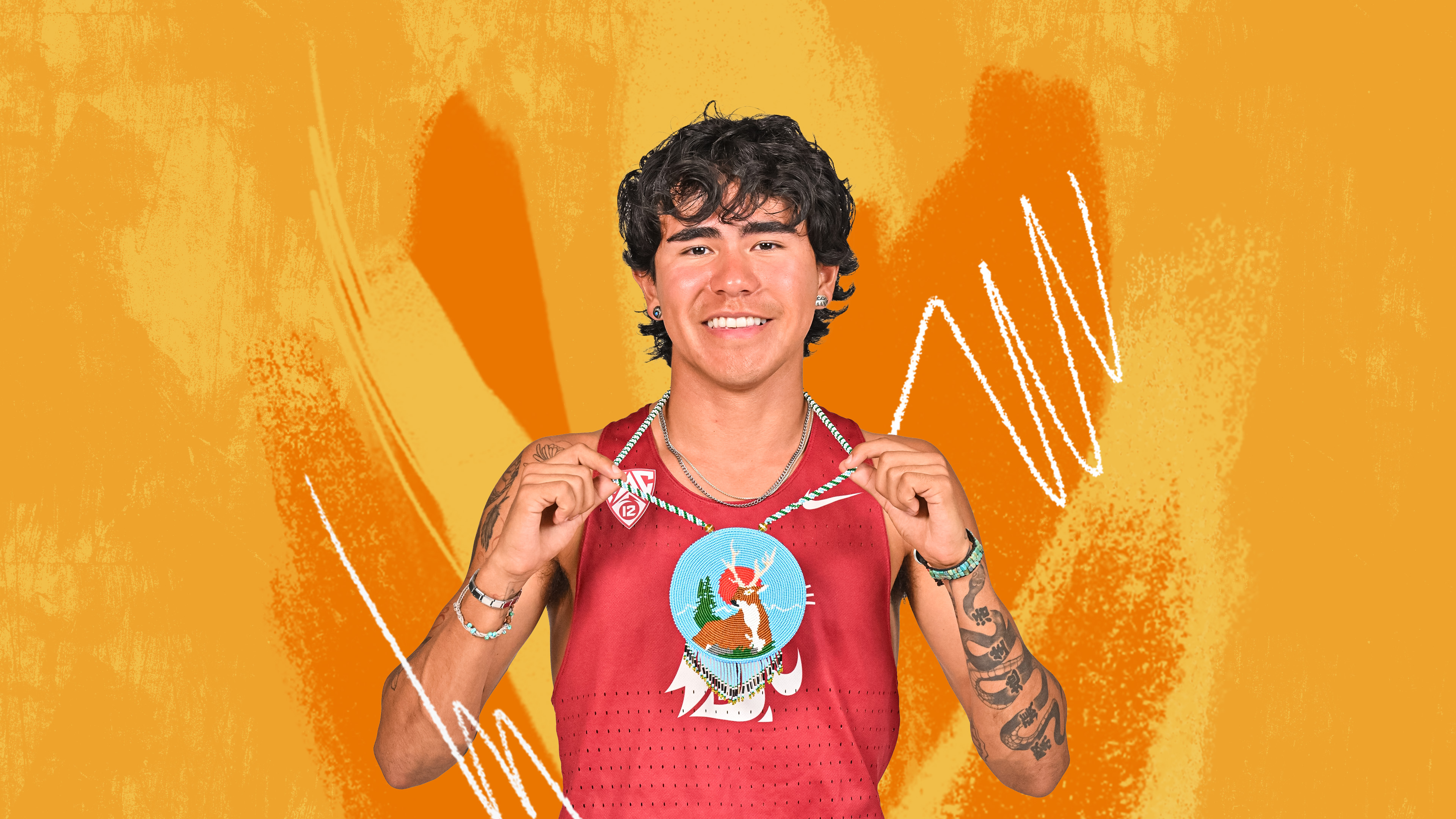
The Washington State athlete runs 50 miles each year in honor of his great-grandfather, who escaped Indigenous boarding schools
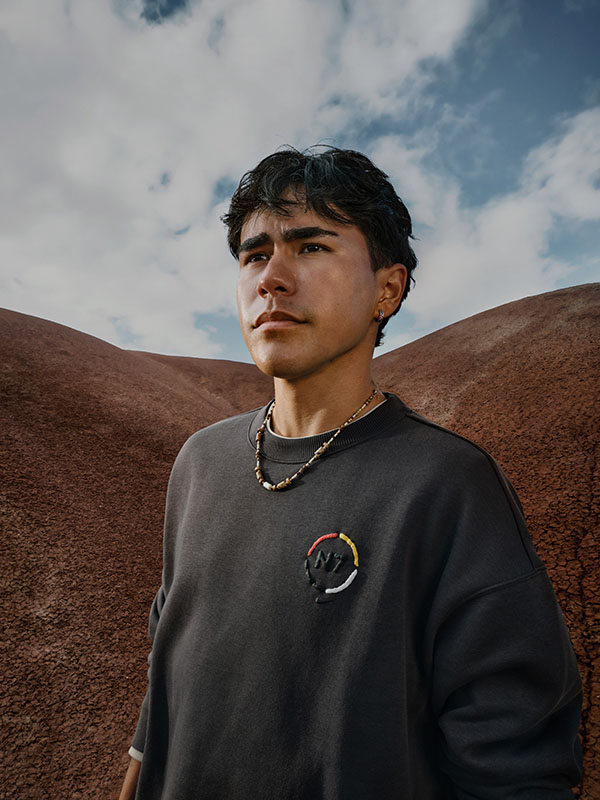
At 13 years old, Kutoven Stevens dropped to his knees and wept.
Running his daily mileage on a dirt road a few miles from his Nevada home, Stevens listened to the audiobook of “Bury My Heart at Wounded Knee” by Dee Brown. The book, suggested to Stevens by his father, detailed a collection of Native American tragedies that had happened since 1492, when Christopher Columbus first came to the Americas. Stevens’ father, part of the Yerington Paiute Tribe, read this book around the same age as his son.
“Another culture deemed us so unworthy of life,” Stevens thought at the time. “To even try and comprehend that a culture so beautiful as my own, that is so pure in our respect for our elders and our earth and our youth and the seven generations to come, we had to endure 500 years of genocide.”
Stevens’ tears dried, and anger replaced them.
“My dad, he really helped me through it. He said when he read that book, he was angry. He decided to focus on his education and become a ‘dangerous Indian.’”
At that moment, Stevens made a decision.
“I wanted to focus on running so I could become a dangerously positive representational Indian,” he said. “After reading that book, I connected my culture to my being, my purpose in running.
“My purpose in this world is to run for the positive representation of my people.”
One in the same
Around eighth grade, Stevens overheard people saying the University of Oregon had the best track and field program in the country.
“They’re the best. I want to be the best. I have to get there,” he thought to himself.
Stevens dedicated the next six years to that goal.
“I was so utterly focused and determined to achieve my dream that nothing could stop me.”
When Stevens was in high school, his running dreams merged with his heritage in an unexpected way.
After news broke of an unmarked mass burial gravesite on the grounds of an Indigenous boarding school in Canada, Stevens and his parents reflected on the 500 boarding schools within the United States, set up to wipe Indigenous youth of their families, their language, their culture.
At just 8 years old, Stevens’ great-grandfather, Frank Quinn, had run 50 miles three separate times to escape the government-run school he’d been forced to attend. At 16, Stevens decided to run the 50 miles Frank ran.
“The run was to raise awareness and for me to better understand and grasp what my ancestors had to go through for me to be here.”
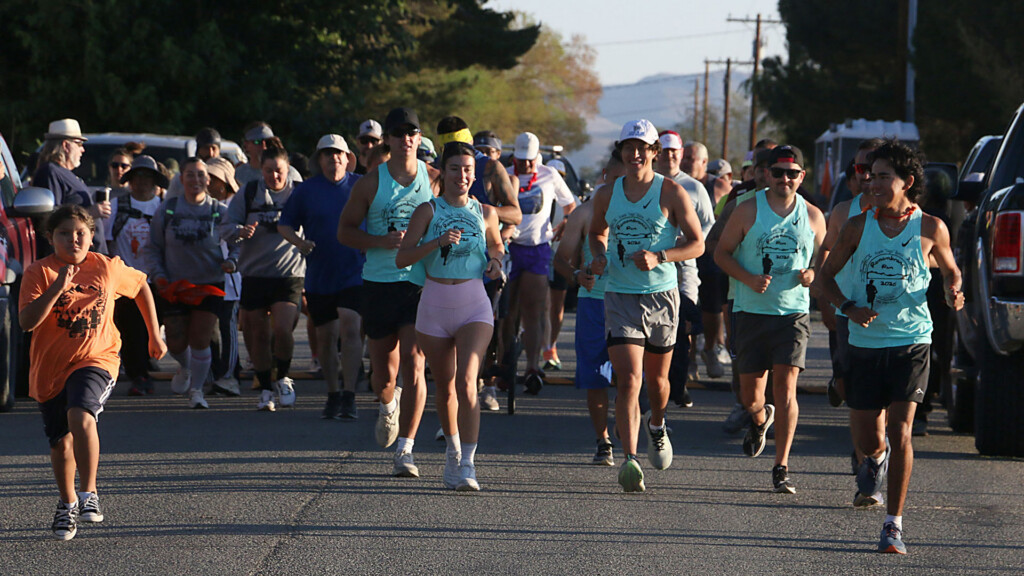
The family posted Stevens’ plan on Facebook, and it went viral. Hundreds of people wanted to get involved, so they decided to host the run communally.
They broke 50 miles down into 25 miles a day, in 5-mile stretches, from the boarding school to Frank’s childhood home. Each stopping point had Native cultural activities, lessons and history. They aptly named the event the Remembrance Run.
In addition to the community run, Stevens has also embarked on the 50-mile run on his own, in one day.
“It was hard, and I wanted it to be hard,” he said. “For me to put myself in his position, for even just a day, for even just a moment, was such a small sacrifice compared to what he did at such a tender age.”
Remaining Native
That initial Facebook post caught the eye of Haudenosaunee filmmaker Paige Bethmann. Her grandmother had been in a boarding school. After recording the inaugural run of the then-17-year-old Stevens, Bethmann learned he aspired to run in college at Oregon.
Bethmann moved from New York City to Nevada and for the next 2½ years captured Stevens’ story, filming his life as he pursued his dreams of running at Oregon.
He achieved his goal. The Ducks recruited him out of high school for cross country and track and field, but before Stevens even got to Oregon’s campus, the coach had been fired and replaced.
Stevens and the new coach struggled to connect, and culturally the two were not aligned. Even while running 110 miles per week as a sophomore, the highest on the team, Stevens didn’t run a fast enough time, and the coach cut him from the program.
“So the seven years that I had spent dedicating half of my entire life was just cut. It was gone.”
Stevens fell into a dark place for months afterward. He could barely muster running a few miles, and he lost his identity.
“After a few months of that, I was fed up. I reached out to Washington State. And Wayne Phipps, he graciously took me in.”
A few weeks after Stevens committed to Washington State, “Remaining Native” debuted.
“I was crying because it was such a delicate time in my life,” he said. “I was 17. Four years later, I’m pretty much an entirely different person.”
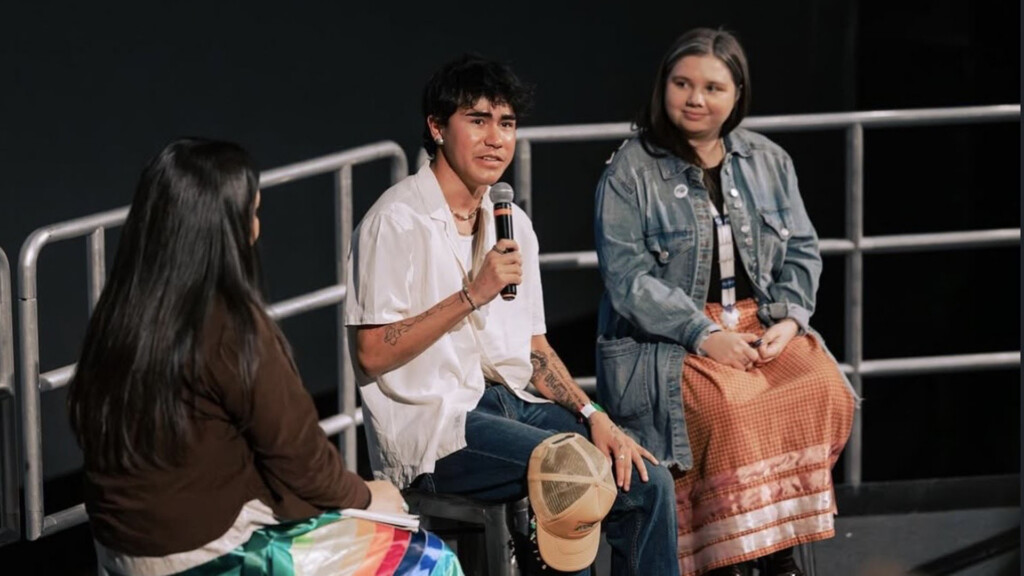
The film debuted at South by Southwest, a major film festival in Austin, Texas, where it won two awards: a Special Jury Award and the coveted Audience Award.
“The film is very well received because it’s so pure at its heart,” Stevens said. “It really was about showing this kid struggling with cultural identity and how he balances his relationship between running and trying to remain Native, in its essence.”
Remembrance Run
With a return to collegiate running on the horizon, watching “Remaining Native” allowed Stevens to reflect on his path to Oregon while charting a new direction running cross country and track at Washington State.
“It felt nice that there was a light at the tunnel, showing me what I could be once again. And that light was the film,” he said.
At Washington State, Stevens had a breakout year, setting PRs, qualifying for the Division I Men’s Cross Country Championships and becoming the fifth Native American athlete to break a 4-minute mile.
“During the span of a year, I was able to turn around this kid who had his dream ripped away from him. I was completely hopeless. It was terrible,” Stevens said. “And I was able to turn it around into a 60th-place ranking at nationals a year later.”
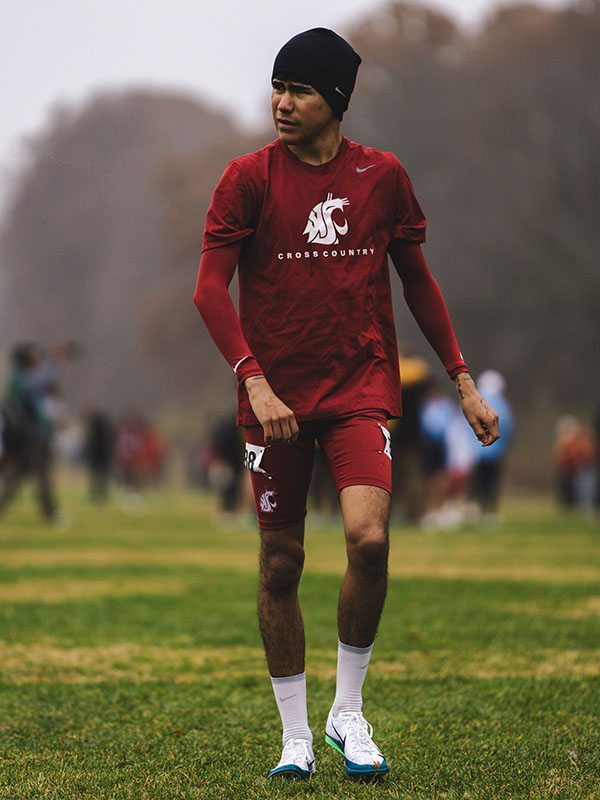
Stevens speaks highly of coach Phipps in this transformation, noting specifically how much Phipps allows him to practice his Native American culture through his running.
“He held me down in so many unbelievable ways. The kindness is what I like to preach about him. He doesn’t consider your worth as a time that you run.”
Each year, Stevens continues to host the Remembrance Runs in his hometown. After last year’s run, a moment with his young nephew, Lenny, solidified Stevens’ purpose.
“Why did we do that?” Lenny asked Stevens after the Remembrance Run. “Why did we cross the desert and camp overnight?”
Steven dropped to his knee, meeting this small child eye to eye. He explained what their ancestor, at around Lenny’s age, had to endure.
“Why?” he asked.
“The school hated everything about you, and that was a tone set by one of our presidents,” Stevens told him.
After running 50 miles, Stevens’ muscles were dehydrated, spasming. He drifted in and out of consciousness, trying to accept as little aid as possible as he finished the ultramarathon. But explaining the generational trauma Native Americans have endured to Lenny was the hardest part of the run.
“But he understood. He understood why we were out there. … He understood the weight, the gravity, of what we were trying to do.
“Fifty miles is a long distance, don’t get me wrong,” Stevens added. “But it’s small in the grand scheme of things. To put yourself out there, to hurt for two days, it’s grounding. It’s healing.”
Stream “Remaining Native” for free through Nov. 27 on the National Museum of the American Indian website.
This story is part of the NCAA’s Tomorrow’s Leaders, Today campaign, which showcases how the college sports experience helps student-athletes build the skills and character traits that contribute to lifelong success.
