

Through his Nigeria Water Project, the wide receiver has helped drill 6 boreholes serving more than 10,000 people
“You don’t need a million dollars to make change; you just need the want and the desire,” Mudia Reuben, a South Florida football wide receiver, said.
That conviction is what turned Reuben’s Nigeria Water Project from an idea into a nonprofit organization.
Funded by donations and a significant portion of Reuben’s name, image and likeness earnings, the project builds deep water wells, known as boreholes, in Nigerian communities, bringing safe and clean drinking water to villages and schools. The infrastructure built by the project often eliminates walks of more than 4 miles to reach the nearest water source, journeys that are often made by children. Reuben’s parents made such journeys before immigrating to the United States and settling in Kansas City, Missouri, in the 1990s.
Reuben, a first-generation Nigerian American, described growing up in a traditional Nigerian household, learning the value of hard work and respect. His parents, Francis and Gladys, endured what he called “pretty labor-intensive childhoods.” According to Reuben, their daily responsibilities included collecting water, tree sap and fruit to sell at the local markets to help support their respective households.
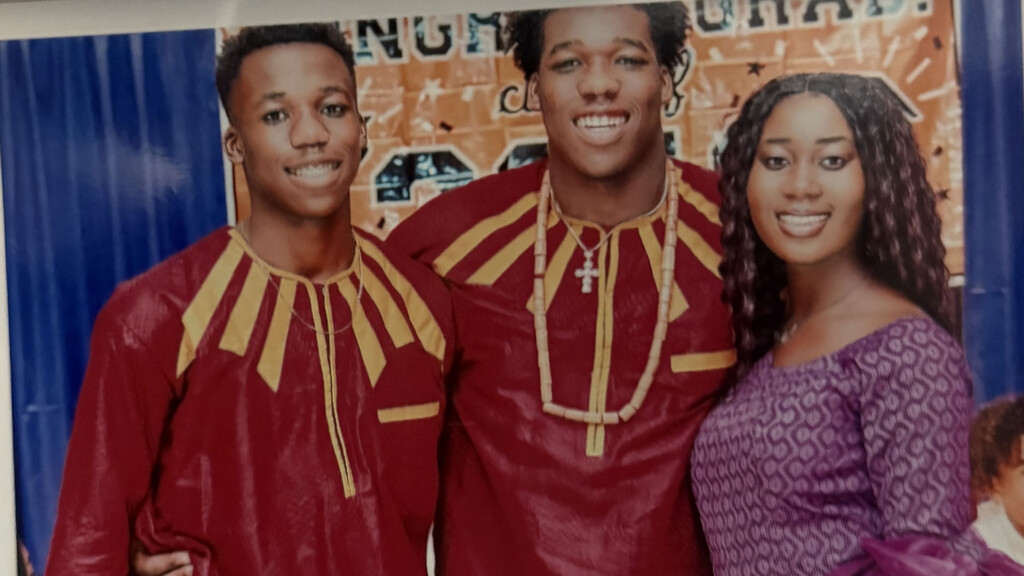
His parents shared these stories with him and his two siblings, detailing the long distances traveled, sometimes barefoot, to obtain the resources their families needed. These stories and the physical reminders on the bodies of his parents were followed by the realities of their extended family members who still live in Nigerian communities where reliable water access remains limited. Some now benefit directly from this project.
“Their stories are what birthed my project,” he said. “It weighs heavy on me that I’m making a direct change. Someone in my parents’ position living in one of these villages won’t ever have to walk that many miles again for what might’ve been an unclean source of water.”
Although Reuben had the desire to help, his initial ideas were smaller in scale — donating pencils, school supplies or monetary donations to established nonprofits working to improve the lives of Nigerians. However, as NIL opportunities expanded in college athletics, so did Reuben’s understanding of the impact he could make.
The idea for the Nigeria Water Project began taking shape in Reuben’s mind in December 2024 while he was a football student-athlete at Stanford. He worked with Stanford athletics’ Cardinal Connect to get the NIL resources he needed to build the Nigeria Water Project from the ground up. Cardinal Connect equips student-athletes like Reuben with NIL skills, tools, education and resources in and around Silicon Valley. It also embeds student-athletes within the Stanford alumni ecosystem.
“I was able to put the project out and get it in front of the right people,” he said. “It started off as just a campaign where people were donating to help the mission.”
Reuben then invested a significant portion of his own NIL earnings in the project. Combined with the donations, his contribution provided enough funding to construct the first borehole. He knew exactly where he wanted contractors to drill it — in his mother’s home village.
By August 2025, the idea that had begun as a fundraising campaign was working infrastructure in Nigeria.
But Reuben didn’t anticipate how quickly the project would gain support. Through the NIL landscape of endorsements, partnerships, Cardinal Connect and his platform as a Division I football player — he soon realized the project could reach beyond one village.
“After I announced the borehole in my mother’s village, I got another influx of donations,” he said. “Thatshowed that there was traction. As the funding started picking up, I told my parents that we might be able to do two boreholes, right now! I remember talking with my dad when we announced the first one, and we’d have conversations about how later on we could build one at the school in the village he grew up in. He knew the schoolmaster and told me about how they hadn’t had water there for so long. … Maybe a week or two after announcing the first borehole, we broke ground on the second one. It all came a lot faster than I thought.”
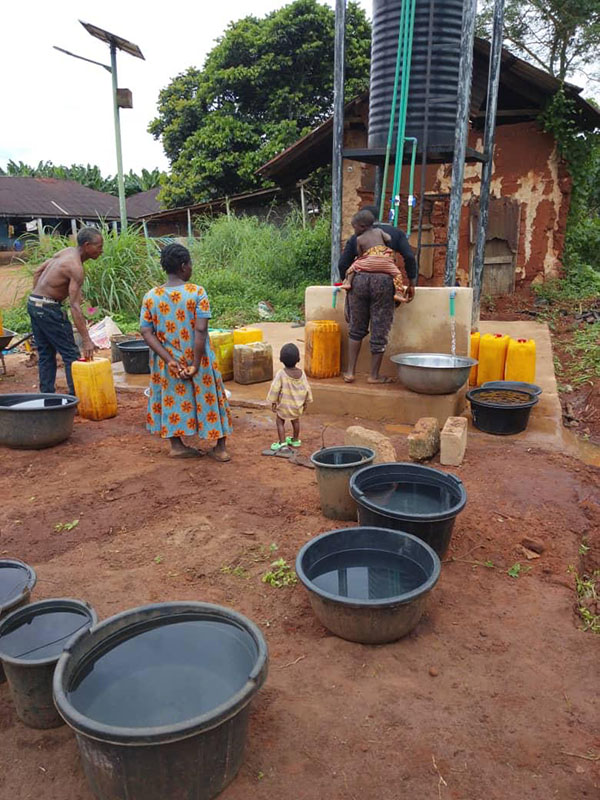
Reuben’s father shared that the schoolmaster, along with families in that community, faced two difficult choices regarding fresh water sources — walk miles to collect it or pay thousands of Nigerian naira for a few gallons.
Funding the boreholes was only the beginning. Reuben still needed people in Nigeria who could convert the project’s financial support into working water systems.
His parents helped him identify community needs, establish relationships and locate local contractors. The contractors then became the project’s boots on the ground, evaluating potential water sources, drilling the boreholes and overseeing construction. Reuben directs the project from the United States while following the work closely through FaceTime, WhatsApp, photos and videos.
“I think there’s definitely mountains with it, but everything’s very doable,” Reuben said. “Once you have that mission, once you have that idea, it’s all about putting the want into it. For me, it was contractors and funding. Once I knew I had those two solidified, there wasn’t anything else really holding back the project.”
The boreholes constructed by the Nigeria Water Project extend more than 100 feet beneath the ground to reach water stored in underground aquifers. A generator-powered pump draws the protected groundwater through steel piping and sediment filters before moving it into elevated storage tanks. Multiple access points then make the water available to the surrounding community or school.
Reuben graduated from Stanford in three years with a degree in life and health sciences and transferred to South Florida in 2025, bringing the Nigeria Water Project with him. While in Tampa, he has continued investing his NIL earnings into the project while using the resources and visibility afforded to him through the athletics department to broaden its reach.
“One of the ways we support our student-athletes is through the Enhancing U program,” Rob Higgins, CEO of athletics at South Florida, said. “We do everything from education around name, image and likeness to the importance of giving back and community service. We also provide financial literacy, tax preparation, etiquette dinners, professional networking and mock interviews. We want to make sure that our young women and men are prepared for everything in the game of life.”
In the spring of 2026, Reuben joined Higgins to speak about the project and the state of athletics NIL to the State University System of Florida Board of Governors Task Force on Intercollegiate Athletics. His participation brought a student-athlete’s voice into the conversation, and the Nigeria Water Project offered a concrete example of how NIL resources can benefit people beyond the athlete receiving them.
“The Board of Governors reached out to ask if I would participate and if we had a student-athlete that we thought could provide a unique perspective. Naturally I couldn’t get Mudia Reuben’s name out of my mouth fast enough,” Higgins said. “To be able to help share his story, his perspective, his ideas, the insight he brought to the table was invaluable.”
With support for the Nigeria Water Project reaching over 2,800 miles from California to Florida, what began as one borehole has grown.
Impact of the Nigeria Water Project
- 6 boreholes and water-storage centers built to serve Nigerian villages and schools.
- 10,000-plus people with safe and clean drinking water access.
- A total of 45,000 liters (about 12,000 gallons) of water storage per borehole, from three 15,000-liter water storage tanks at each site.
- $20,000 generated for the project.
- Communities impacted: Uvbe, Urhokuosa, Ebue-Neki, Iguovbiobo, Ohovbe and Fortress Academy.
Reuben’s commitment to serving has earned him national recognition. He was named to the 2026 Allstate American Football Coaches Association Good Works team and was a semifinalist for the 2026 Allstate Wuerffel Trophy, which recognizes an FBS player for community service, leadership and achievement on and off the field.
The six boreholes are just the beginning for the impact Reuben wants to make.
He is currently pursuing his master’s degree in pharmaceutical nanotechnology and biomedical engineering, with the goal of developing affordable health technologies and solutions for underserved communities. He also aims to expand the Nigeria Water Project to include more opportunities for children through sports.
Through the Nigeria Water Project, Reuben has developed a clear understanding of what he wants his name, image and likeness to represent.
“I think the project serves as a pillar that in our era of college football with NIL, this money goes a long way,” he said. “I think it also serves as a testament to other first-generation immigrant children that they can be interconnected with their bloodline. It’s a good way to leave a long-lasting impact on your culture.”
—
The Now Era highlights how the NCAA and member schools are supporting current and future student-athletes by continuing to invest in expanded benefits, educational opportunities and resources for success beyond graduation.
