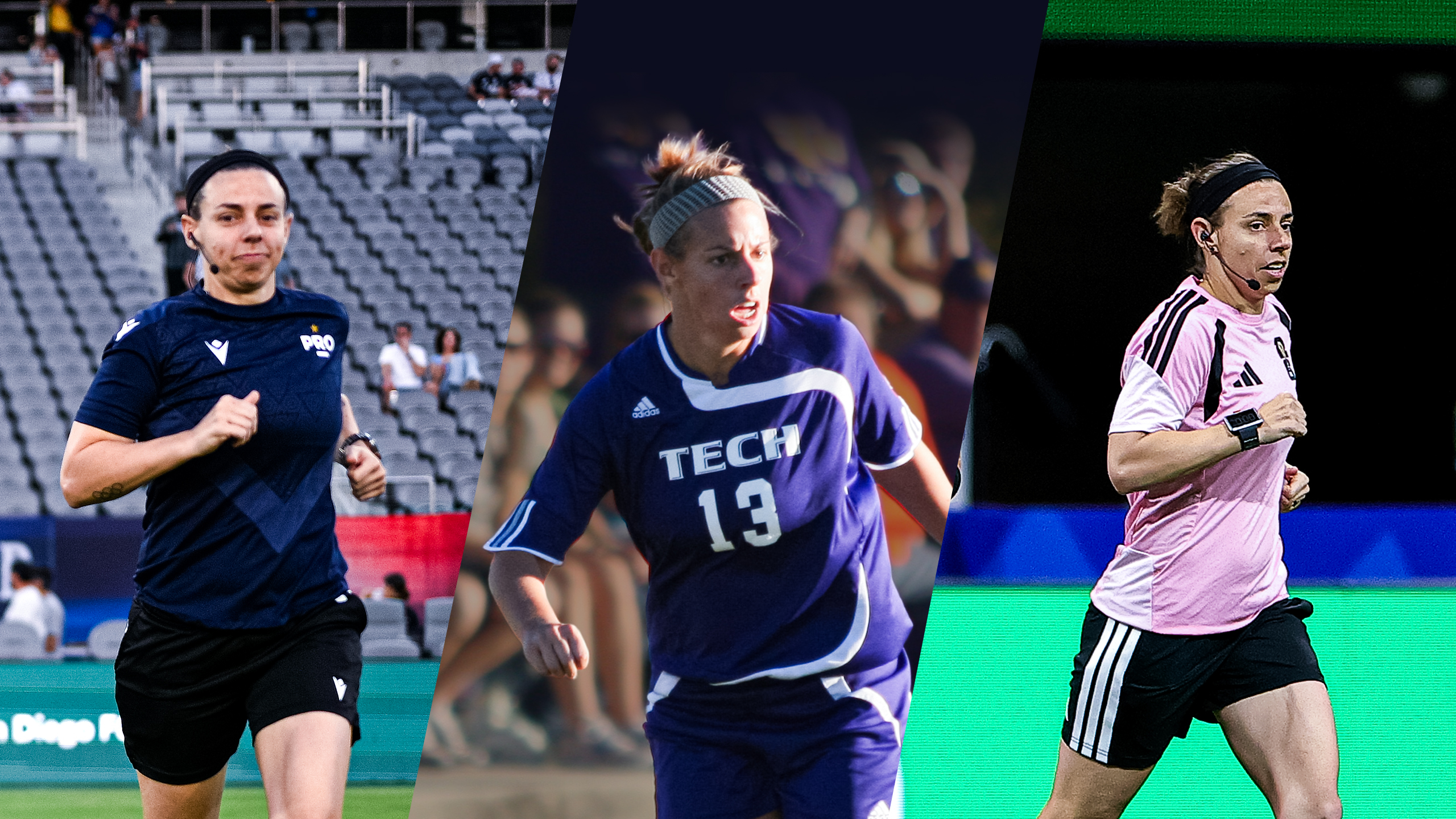
The Tennessee Tech soccer alum is the first openly gay official to call a men’s World Cup game. She’s a fan at her core.
Brooke Mayo knows what it’s like to be the first.
She made history as a member of the first all-American, all-woman officiating trio to call a FIFA men’s World Cup game in 2026. In the same game, she became the first openly gay official on soccer’s biggest stage.
But inside the assistant referee lacing up her boots alongside soccer’s greats is still the 13-year-old kid who needed Xbox money and couldn’t get enough of her favorite sport.
“The first game I ever did, I made $9, cash money,” Mayo said with a grin.
From rec fields to the World Cup
She continued officiating throughout her career as a forward on the Tennessee Tech women’s soccer team.
When her playing career ended, she was offered a spot in the local chapter of officials doing college games. It started with a fitness test.
She showed up out of shape in the haze of an identity crisis that often accompanies the end of an athlete’s career. She hated fitness tests in college, but this one felt different.
“I looked around me at the people passing the test, and there were people older than me passing the test. There were people that looked different than me passing the test. And I was like, ‘I’m capable of this.’ It kind of brought out that competitive edge in me,” Mayo said.
That competitive edge ignited when she saw her officiating peers on the field alongside the world’s star players.
“And I’m looking at (other officials) and looking at me, and I’m like, ‘Wait a second. I can be on the field with the players I’ve looked up to my entire life,’” Mayo said. “And then I started seeing that competitive fire, like, ‘Let’s do it. I want to make it.’”
In June, Mayo took the field in Atlanta with the Czechia and South Africa teams at the FIFA World Cup. She walked out of the tunnel alongside Tori Penso and Kathryn Nesbitt. When Penso blew the whistle, the trio became the first all-American, all-woman officiating crew to call a men’s World Cup game ― on home soil, no less. Mayo became the first openly gay official to achieve that same feat.
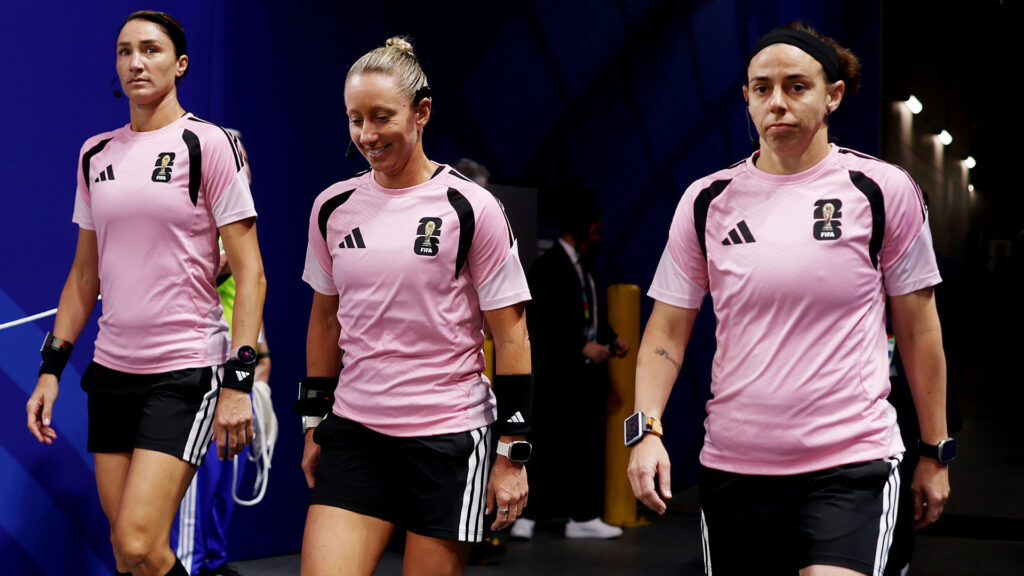
“(The walkout is) your time to really just enjoy it, sink it in, be like, ‘I made it,’ see your family in the stands,” Mayo said. “The players are doing the same thing. They’re crying, they’re looking around, they’re representing their country at the highest level. It’s everybody’s moment, the calm before the storm.”
The calm before the storm is punctuated by the national anthems of both teams.
“Some countries don’t have spectators there, but they’re screaming their national anthem. And that does something to you. You just feel how important it is. Their backs are against the wall. No one’s supporting them, and they’re belting out their national anthem and they’re ready to play for the pride of their country. And that gets me as a sports person. I’m like, ‘They’re ready to go. I need to be ready to go,’” Mayo said.
A fan behind the whistle
Even when the stakes were the highest, the hardest part of officiating a World Cup for Mayo was sitting in the stands watching the best soccer in the world ― without showing emotion.
“It’s really difficult to sit there at a World Cup event with all the passion and see a brilliant play, we don’t care what country it is, just to be able to sit there straight face because we’re the refs and can’t acknowledge it. But some plays are so nice that as a soccer fan, you just want to be like, ‘Let’s go,’” Mayo said.
That’s the unifying factor between the often-misunderstood officiating crew, the players on the field and the fans in the stadium: the love of the game.
Mayo’s experience spans more than 100 MLS matches, the 2023 Women’s World Cup, the 2024 Paris Olympics, the National Women’s Soccer League and NCAA competition. U.S. Soccer named her its 2025 Female Official of the Year.
She makes it a point to congratulate players on career milestones or welcome them back to the pitch in their return from injury. Equally important as expressing her love for soccer to the players is taking accountability when she makes a mistake.
“I remember I was reffing Jamaica and I called offside on something and it ended up going to review and it wasn’t offside. And I mean, they were eating me alive. It was the men’s team. They were eating me alive. And after the review, I just turned around to the whole bench, and I was like, ‘Hey guys, my bad. I really hate to make a mistake, and I’m really sorry,’” Mayo said. “And now anytime I see them, they come and shake my hand.”
Accountability builds relationships with the players, but it can only do so much to help officials manage their own expectations for their performance.
“Normally we can’t sleep after games, even if we do well,” Mayo said.
She gives herself 24 hours to be “as mad and angry” as she wants about her performance during a game. She sends videos of the match to two fellow assistant referees for feedback and a pick-me-up.
“I’m going to post a video there, and they’re going to light me up, tell me what I need to do better, and then be like, ‘All right, time to move on,’” Mayo said.
The relationships she’s built with fellow officials, who challenge her to be better while helping her keep her chin up, remind her of the bond she shared with teammates at Tennessee Tech — people she wouldn’t have chosen as her friends who became her family.
“You go through some crazy situations, and afterward, your relationship is almost unbreakable,” Mayo said. “You’re spending hours with these people before the game, then you’re going to battle with these teams during the game, and then dealing with the aftermath of maybe making a mistake or whatever happened during the game, and you’re riding back together and talking to each other through that.”
The freedom to be herself
Those relationships go beyond the field.
With Penso’s support, Mayo chose to come out as a member of the LGBTQ+ community in 2024. Growing up in the South, she felt she had to be guarded with her sexuality for the sake of safety.
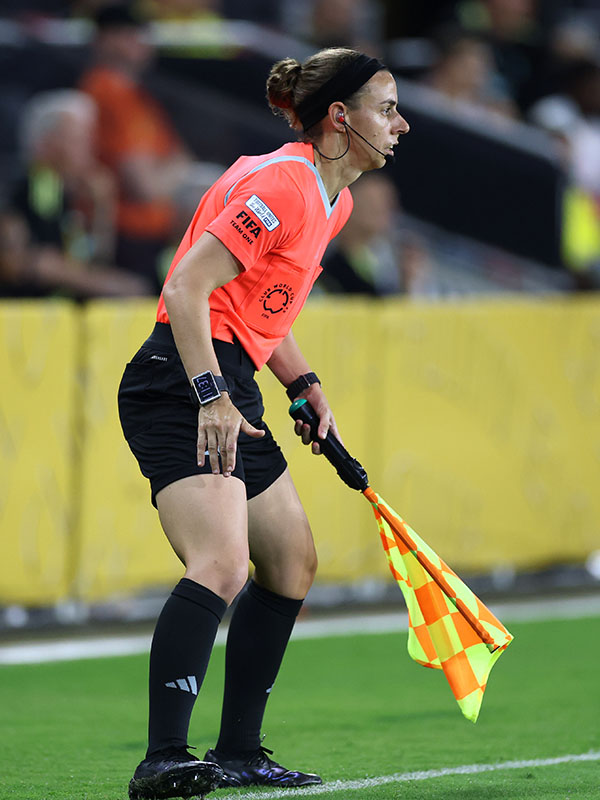
“I always believed in keeping my personal life private and letting my actions, how I move through the world, how I treat people and my core values, let that change their opinion of me naturally,” Mayo said.
People told her she could never be out and make it as a FIFA referee.
“And then as you move up the ranks and you gain a platform, you realize you have a responsibility, not necessarily responsibility, you have an opportunity to make a difference in a lot of people’s lives who feel like they can’t safely be out, just by being your authentic self,” Mayo said.
Mayo’s wife encouraged her to “be honest in front of all these people” at the United Soccer Coaches Convention after the Women’s World Cup. She came out on stage during a Q&A.
“I had multiple people come up from the crowd and thank me, whether it was because they had a brother or a sister or somebody that was in the closet or hidden,” Mayo said. “They said, ‘Thank you for saying that,’ and I was like, ‘Wow, just being myself and I can inspire people.’”
She shared her story in a blog post titled, “We are all One Family” for the National Intercollegiate Soccer Officials Association in 2024.
Today, Mayo is a visible gay woman at the top of her game. From student-athlete to world-class official, she’s always felt the freest on the soccer field.
“Yet there is one place where I feel the most supported being my authentic self, the soccer field,” Mayo wrote in the 2024 post. “Soccer is truly a beautiful game that has the capability of uniting the world.”
NCAA Player to Ref Program
The NCAA Player to Ref program helps student-athletes stay connected to the sports they love by exploring opportunities in officiating, with training and resources available to help them get started.
Learn more about the NCAA Player to Ref program and take the first step toward becoming an official.