
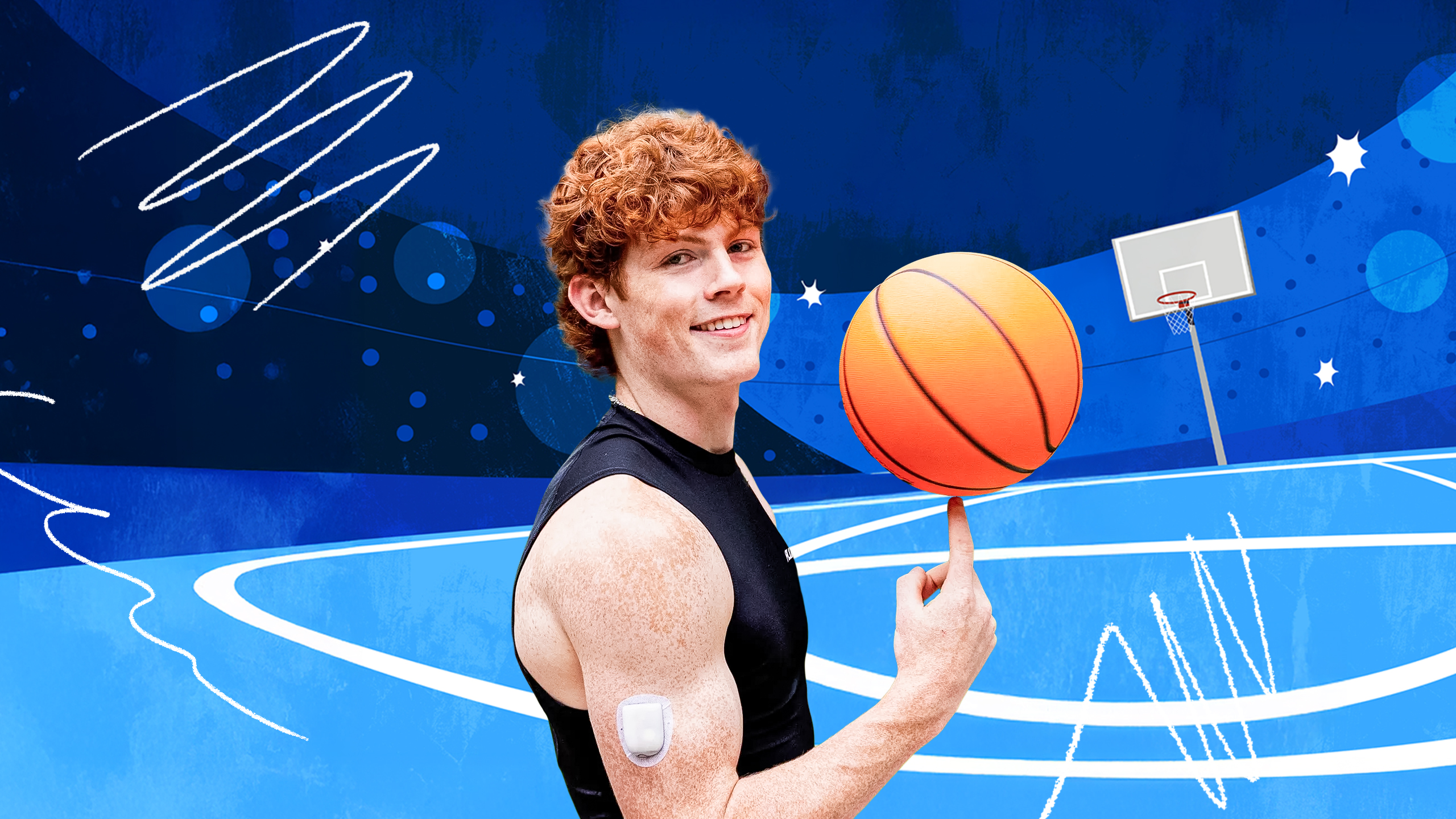
The Bentley forward used to hide his diagnosis. Now, he’s ‘diabetic Spider-Man’ for the young T1D hoopers of the world.
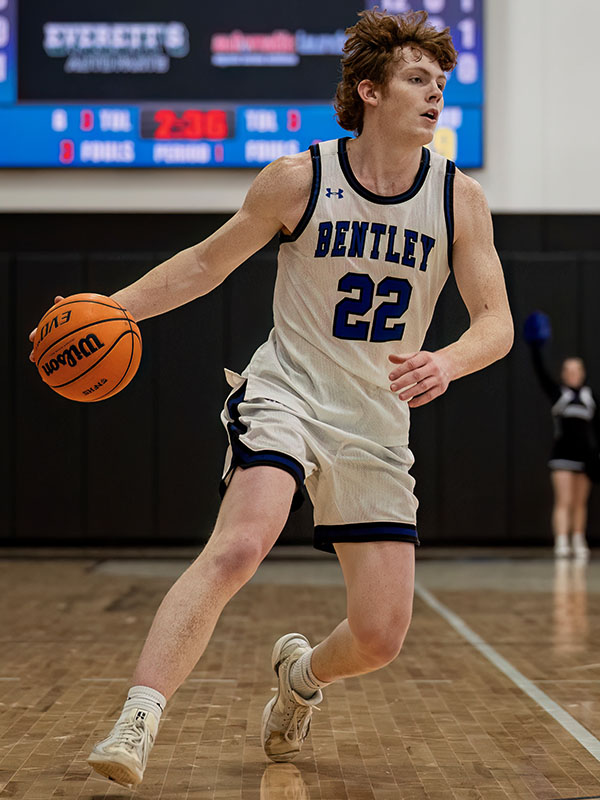
Cooper Farrall grew up in the heart of basketball country. At age 12, he persuaded his parents to put up a regulation-sized basketball hoop in the living room, but the future All-Northeast 10 first-team forward experienced the game differently than most kids in Valparaiso, Indiana.
During a family road trip when he was 11, Farrall wound up in the hospital with a blood sugar reading of over 1,000 mg/dL. A “normal” reading is below 100 mg/dL. He was diagnosed with Type 1 diabetes, a chronic autoimmune disease in which one’s pancreas produces little to no insulin.
Farrall’s body is not self-regulating. He can eat, and do, whatever he wants, but he relies on his automated insulin delivery system, or pod, to deliver the insulin his body needs to convert the sugar that enters his bloodstream after eating into energy. The wearable pump attaches to his body, acting as an “external pancreas.”
Now a standout senior basketball player at Bentley, he considers factors like what he is eating, when he is eating it, what physical activity he will be doing and how well-rested he is when planning his days.
In between insulin decisions, basketball practices and homework assignments, Farrall thinks about camera angles and trending audio tracks. He began sharing his experiences as a student-athlete living with Type 1 diabetes on social media in March 2025, hoping to become a role model for young athletes with the disease. He’s amassed over 13,000 followers on his Instagram account, @t1dhooper.
‘Basketball and diabetes happened at the same time’
Unfolding between free-throw reps in the Farrall household were moments of anger, confusion and frustration.
Research shows people with Type 1 diabetes make, on average, 180 more decisions a day than people who don’t have the disease. Farrall had no interest in making those decisions in the years immediately following his diagnosis, when the emotions, and the denial, were the highest.
“(Cooper) and I started fighting a lot because he didn’t want to dose (insulin). He didn’t want to count his carbs. He’s leaving for something, and I’m like, ‘Do you have sugar with you?’ And he’s like, ‘No,’ and I’m like, ‘Honey, you can’t leave the house without (sugar),’” Farrall’s mom, Liz, said.
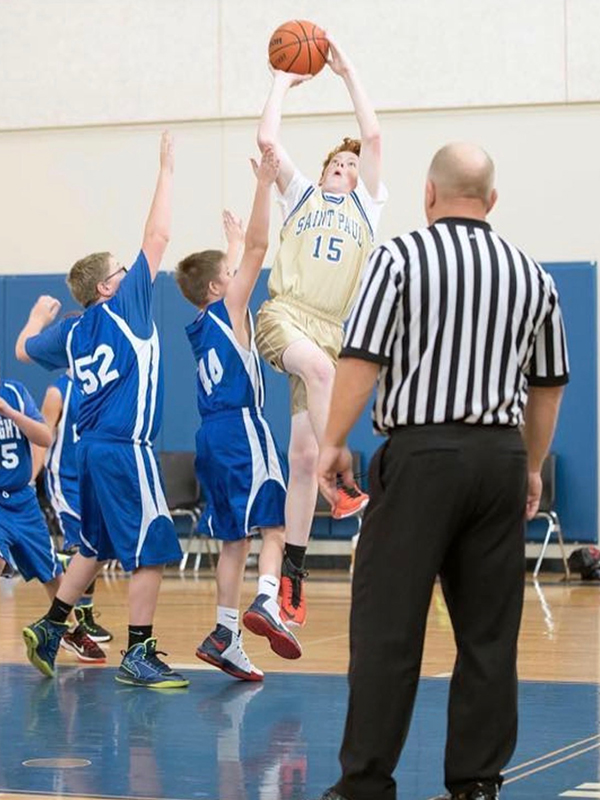
“We would just yell and yell and yell. My dad would get in fights with my mom. My mom would get in fights with me. Then, I would go to my sister Grace, and my sister Grace would yell at me and then yell at mom. It was just chaotic,” Farrall said.
Grace, one of Farrall’s older sisters, also has Type 1 diabetes. She was diagnosed at age 10.
At 11, Cooper Farrall didn’t want to accept that his condition made him different.
“You’re just like, ‘Oh my gosh, can you not talk to me right now? Like I don’t want to hear a single word out of your mouth.’ And then that night your blood sugar goes low and your mother needs to save your life, and the last thing that you told her was, ‘I don’t want to hear from you. I don’t want to talk to you whatsoever,’” Farrall said.
Denial evolved into shame. He did everything he could not to take his diagnosis into the gym with him as his passion for basketball grew throughout high school.
He kept his pod and his continuous glucose monitor — a small device that sends his blood sugar reading to his phone via Bluetooth — hidden on his lower back and butt. He continued playing and practicing through low blood sugar episodes, unwilling to step out and sacrifice an opportunity to get better.
It took Farrall 8½ years to accept his diagnosis. He hopes that by sharing his experience, he can ease the path for other families navigating Type 1 diabetes.
“I wish I could have done it differently. And that’s what I just want to help these kids with. Because, yeah, you can be ignorant. Ignorance is … bliss, I will tell you that. But in the grand scheme of things, are you hurting your body in the long run?” Farrall said. “I want to help these kids live as long as they can.”
Growing up
Farrall arrived at Bentley as a freshman in 2023 determined to stand out for the “right” reasons. He was guarded about his diagnosis.
He cracked the starting lineup as a sophomore, putting together a 2024 season that would earn him second-team All-Northeast 10 and Academic All-Northeast 10 honors.
Joel Godett, director of strategic communications and digital media for the Northeast 10, took a special interest. A Type 1 diabetic himself, Godett noticed Farrall’s glucose monitor. He reached out to Bentley’s sports information director with a question: Does Cooper Farrall have diabetes?
“If I had asked somebody at Bentley, ‘Who has a cool story?’ would this one have come to the forefront? Probably not. Because who would know? It’s not something you would know or talk about. It only happened because I knew what to look for, and I saw (the CGM) and was like, ‘Hmm. I want to tell that story.’”
Godett and Farrall sat down for an interview in February 2025. Their shared condition changed the trajectory of the interview ― and of Farrall’s life.
“There’s a certain level of connection that you can really get with another Type 1 diabetic. And it just kind of clicks. … That was really the first time I got to show that I was a Type 1 diabetic and explain it to somebody who understood,” Farrall said.
Eighteen months later during an interview at the NCAA national office, while reflecting on his experience with Godett, the CGM on Farrall’s arm beeped, warning him that he was “going low.” He ate a handful of fruit snacks to bring his blood sugar back up before getting back to business.
Farrall’s interview with Godett posted in March 2025. Liz noticed her son inhaling before answering each question, seemingly stilling himself. She heard a quiver in his voice. It was the first time he spoke openly about his condition.
“He never talks about it. It was shocking because he hadn’t ever acted that way,” she said. “I was really proud of him. We all were.”
Farrall walked away from the interview feeling ambiguous. He was glad it was over, unsure of what to expect when it was posted and apprehensive about taking the spotlight away from his teammates.
Eight months after the interview was released, Farrall spotted Godett shooting photos near the endzone at a Bentley football game. Farrall yelled Godett’s name and pulled up his Instagram page on his phone. He showed Godett that @t1dhooper already had over 10,000 followers.
Farrall started the account after receiving countless messages from parents and young Type 1 diabetics thanking him for sharing his story.
NIL for good
When Farrall began creating content, he did what he saw everyone else doing.
“I’ll be completely honest. When I started my content creation, I was like, ‘How can I make money?’ Because everything that was being shoved down my throat was NIL, everybody getting paid, everybody getting stuff, protein bars, protein powder, electrolytes. I want that,” Farrall said.
It took him all of three weeks to realize that wasn’t going to work for him. He experimented with different marketing agencies and styles of content. After months of trial and error, Farrall found his lane: giving back, and doing it as his authentic self.
“I got here through failure, through trial and error, through talking with peers, through crying, through countless nights of not being able to sleep. That’s what this is about, that’s what my journey is about, and being able to relay that to people, to kids, to athletes, to families, to let them know that it’s OK to fail.”
He began accepting speaking engagements and organizing basketball camps for kids with Type 1 diabetes.
Five campers showed up to his first camp, hosted in the summer of 2025. Farrall felt embarrassed by the turnout until he asked himself: Is this what 11-year-old Cooper would have wanted?
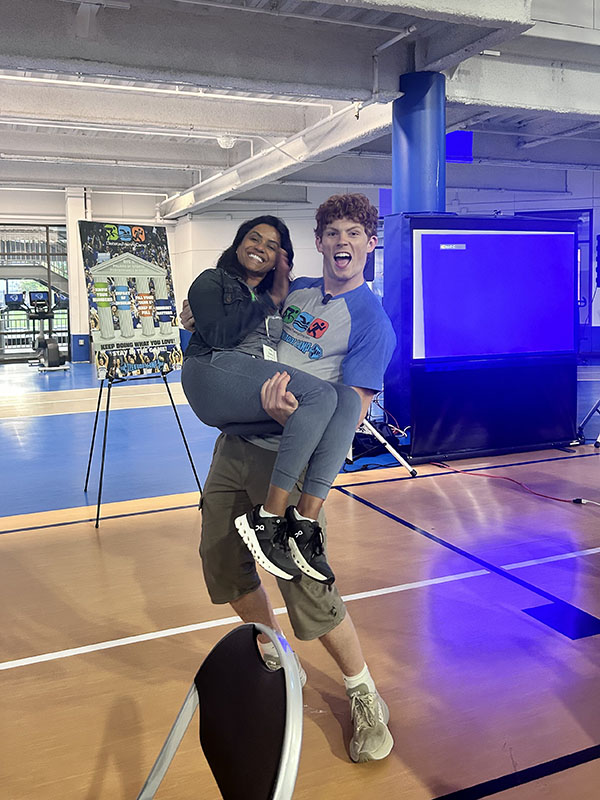
“If there was a camp to do and (young Cooper) was able to make five new friends, that’s a win,” Farrall said.
He partnered with La Rabida Children’s Hospital in Chicago, where he received his diabetes treatments as a kid, for his second camp in the summer of 2026. Twenty-four campers attended, and Farrall was able to donate $500 in proceeds to La Rabida.
Farrall’s content has appeared on local news channels, ESPN and “SportsCenter.” He speaks at universities and diabetes camps across the country. He starred in the NCAA’s “Make It Yours” campaign, highlighting the unique opportunities for “life in the balance” afforded to Division II student-athletes.
“I can’t wait for (the Division II commercial) to come out because then I’ll have kids looking up to me like a superhero, like I’m Spider-Man,” Farrall said before the spot launched. “That’s what I would have wanted when I was 10 or 11.”
He feels his impact most in the small moments of connection with the Type 1 diabetes community. At his camp this year, that meant giving campers a run for their money in a game of knockout.
“They were going to have to find out the hard way,” he joked.
An iPhone video captured Farrall going head-to-head with one of his campers. Watching that video, he realized he’d done exactly what he set out to do: be the representation he wished he had as a kid.
“You could just see in his eyes, (I) was just another kid next to him. That’s what I want to be, joking, talking trash with him, being able to really just enjoy the present moment with him. That’s all that I’d really ask for,” Farrall said.
