
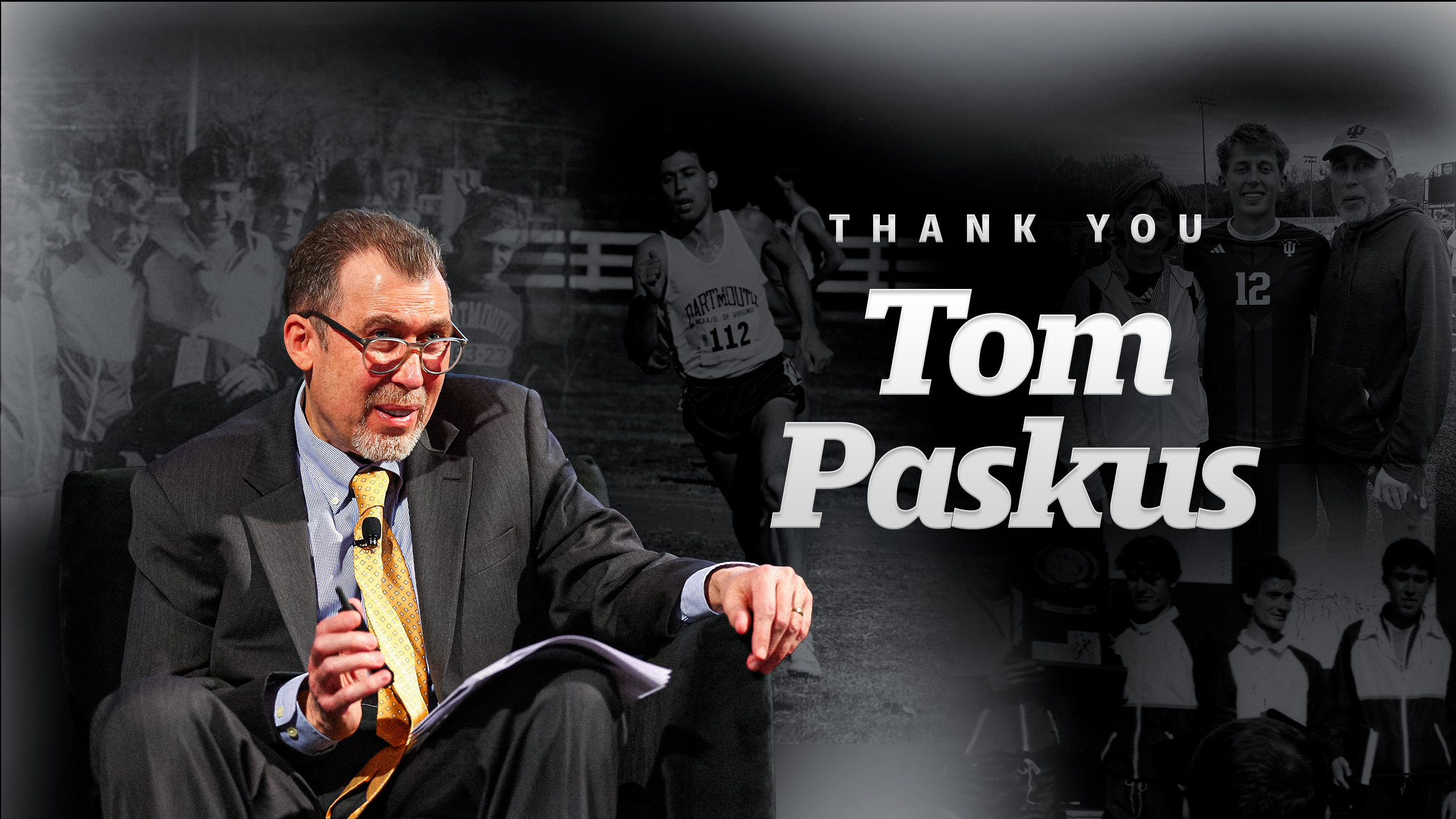
Paskus’ work led to progress-toward-degree and initial-eligibility standards, Academic Performance Program
Tom Paskus’ work contributed to some of the most important policy decisions NCAA members have ever made, including initial-eligibility standards, progress-toward-degree requirements and the Academic Performance Program.
But if you ask Paskus, who retired from leading the Association’s research team earlier this spring, that’s not what he’s most proud of in his 20-plus years with the NCAA.
“I’m most proud of the team that is there now, helping pull together that group and have them be doing so awesome, be so wonderfully led by Lydia (Bell) and Keke (Liu) and Paige (Kadish),” Paskus said. “I felt bad leaving, … but I knew the group was ready.”
Paskus’ official departure was in April, but he began a medical leave in early 2025, about four years after he was diagnosed with Parkinson’s disease. That diagnosis, more than four years after he began experiencing symptoms, could have led to his immediate retirement were it not for the twin blows of the COVID-19 pandemic and the subsequent departure from the research team of several longtime staffers who took early retirement or separation packages, which meant their positions could not be refilled for a period of time.
“I really felt I needed to stay and help that group survive,” Paskus said. “I just felt like it was important for those folks to help save their positions and keep the research production at the clip it had been going at.”
But last year, his family and his doctor convinced him that it was time to step away. Lydia Bell, the current managing director of research, worked alongside Paskus for 13 years and thinks the team was ready because Paskus took great care to make them that way.
Paskus and his predecessor, Todd Petr, who left the Association in 2021, built the research team from fewer than five people in the early 2000s to the diverse, 12-strong staff it is today. The spectrum of perspectives and backgrounds on today’s research team makes the group stronger and better able to serve the diverse needs of the membership, committees and staff.
“He always said there is no ‘right way’ to be a research staff member. There never has been,” Bell said. “He had this sense for people, that they would be a great contributor even if their prior work wasn’t exactly aligned with what we were doing.”
That diversity in perspective wasn’t just sought at hiring time under Paskus’ leadership — it helped make every project, every presentation and every idea better and stronger. He emulated for the team his belief that titles didn’t matter and that everyone’s thoughts were valuable and should be considered.
“He wanted feedback from everyone and wanted to give feedback to everyone. The constant sharing of ideas was key,” Bell said. “Suggestions coming from all sides is something we continue to aspire to.”
While the team is the thing he’s most proud of, the work he did while a member of the research team is nothing short of remarkable. Bell and others called him “brilliant,” and data he collected and analyzed informed important policy decisions and ultimately helped more student-athletes be prepared for college (initial-eligibility standards), earn degrees (Academic Performance Program) and have a better experience in college (Growth, Opportunities, Aspirations and Learning of Students in College and the Student-Athlete Well-Being and Health and Wellness surveys).
He specifically mentions the NCAA’s move away from test scores as an initial-eligibility metric as a data-based decision he was proud to help support.
Beyond the work that led to policy decisions with enormous positive outcomes for student-athletes and college sports overall, NCAA members relied on Paskus at a time when all different kinds of committees turned more frequently to data and research to guide their decision-making.
In presenting Paskus with the David Knight Award at the 2025 Faculty Athletics Representatives Association annual meeting, Kevin Lennon, former NCAA senior vice president of policy and governance, credited him with informing many of the most important decisions the membership made over the past 20 years.
“Tom has been part of and led an incredible research team and colleagues that represent the very best of the NCAA, and (their work illustrates) how the organization adds value and provides the foundation from which the most elite collegiate competitions can add to the experience of young people enrolled on our campuses,” said Lennon, who retired from the NCAA in 2025. “‘Informed decision-making’ was not some hollow phrase. It meant relying on data to guide decision-making, … and Tom was right in the middle of all of it.”
Bell also praised Paskus’ accomplishments, particularly in working with committees.
“Think about the changes that have been made (as a result of committee decisions informed by Paskus’ research) and the outcomes you can tie back to the thoughtful policy considerations,” Bell said. “He has a real knack for explaining data to people in a way that was digestible and tangible and helped them make informed decisions and feel confident they were doing it because they understood the data.”
Beyond the research and data accomplishments, Bell said Paskus helped her understand that her value — the value of any research staff member — was more than the work she produced each day. Paskus modeled balancing work and family, said Bell, who started at the NCAA when her child was under a year old.
“Both (Petr and Paskus) were super committed to their work, but they always emphasized the importance of family,” Bell said. “Tom was always coaching his son’s basketball teams, so he was often on the road by 4 p.m. because he had to be at practice. … (I worked) for two men who were so clear that being an active parent didn’t make you less committed to your work.”
Part of the reason for Paskus’ dedication to the Association was his identity as a former student-athlete. A cross country runner at Dartmouth, Paskus was part of multiple teams that competed for — and almost won — national championships.
In addition to exceling on the field, Paskus earned a degree in psychology from Dartmouth and then did graduate studies at Virginia, eventually earning his Ph.D.
A mentor, Jack McArdle, was instrumental in steering Paskus to the NCAA, tracking him down at his gap-year job working at a halfway house for schizophrenic outpatients in Hanover, New Hampshire. McArdle sold him on the work he could do improving college sports. As a postdoc, Paskus did a two-year stint with the NCAA that spanned the time the Association moved its headquarters from Kansas to Indiana. Paskus then headed to the University of Denver to be a member of the faculty in the College of Education, though he continued as a consultant for the NCAA.
Shortly after he and his wife, Lucy, began having children (Molly is now 23, and Grant is 20 and a soccer student-athlete at Indiana), Petr offered Paskus a job as research director with the NCAA.
“The whole notion of doing work today that is helping people make decisions a few weeks down the road as opposed to the regular publication process in academics when you could be waiting months and years for something to be read by 15 people,” he said. “I made the decision to come to Indianapolis in 2005, and I never looked back.”
He spent the next 20 years shaping policy decisions in all three NCAA divisions, using all his experience to that point to better support committees and student-athletes.
“Having been a student-athlete myself, it meant a lot to me to provide meaningful and accurate data to guide decisions,” he said. “I did not expect the ending to go as it did.”
Paskus began having Parkinson’s symptoms in 2017, just a feeling that something wasn’t quite right with his body, especially on runs. His body was exerting a lot more energy to do things than it used to. His handwriting began to deteriorate, followed by involuntary spasms and tremors. He was misdiagnosed for a while, and the puzzle that was his health led him to commit to exercising every day — a streak that began Jan. 1, 2019, and continues to this day. The commitment was a way for him to control something about his physicality.
Last summer, Paskus discovered Rock Steady Boxing, a program specifically for people with Parkinson’s. Founder Scott Newman discovered that boxing helped his symptoms, and Paskus and his doctor went together to check the program out. Paskus found an important community in the Rock Steady gym a couple of miles from his house. Two or three times a week, he has sweated it out with about 40 other Parkinson’s patients. They don’t box each other but do a lot of speed bag and heavy bag work, circuit training and core work.
“We sweat and fall down and look foolish with each other and support each other, and it’s been a huge thing for me,” Paskus said. “It’s really cool.”
A broken collarbone suffered in a fall on the stairs at his home recently has kept him away from his Rock Steady community for a little while, but he looks forward to going back at least to cheer on his compatriots as soon as he can move around without significant pain. He credits his time as a student-athlete with influencing his outlook since his diagnosis.
“It definitely affects how I am at Rock Steady. I try to be the guy who is going around high-fiving people. I want to foster that team environment among people who haven’t been in that environment before,” he said. “On the personal side, it’s like being an NCAA distance runner. It’s grueling. It’s a tough process, and you have good days and bad days, but you keep fighting through and managing it.”
Paskus’ son is majoring in statistics at Indiana, but with more of a focus on athletic performance metrics. Paskus doesn’t know what advice to give him or others like him because the world is changing so rapidly with the advent of artificial intelligence and other technologies.
“The main thing is to find what excites you and find different ways to learn about it and pursue it, through coursework, internships, collecting data or scraping data off the internet and running your own models. Figure out what excites you and pursue it,” he said. “For me, it was wonderful confluence of things. … I don’t know if there is one best pathway. You just have to take advantage of the opportunities life puts in front of you.”
Bell has a long list of things she and her team will miss about Paskus, including his dry sense of humor, the importance he placed on family and his brilliance. She also misses his ability to gently guide a committee toward making a philosophical decision instead of making data requests that may not inform that decision and how he emphasized the importance of transparency with the NCAA’s data.
His influence on college sports over the past 20 years is undeniable, but his imprint on those who knew him is even more clear.
“We know (Paskus) to be a man of integrity in his work, with a commitment to excellence and an extraordinary work ethic,” Lennon said. “But being around Tom is usually filled with laughter, bright eyes and engaging conversation that makes you better. He faces new challenges, and he faces them today as he always has — head on, holding nothing back and taking on the day.”