
Before skiing for Team USA, the former cross country and track athlete learned to embrace change and community
As a kid, Dani Aravich never thought she’d be a college athlete one day, let alone a professional athlete and three-time Paralympian.
Now, Aravich is days away from competing in her second Paralympic Winter Games — and third Paralympic Games overall — as a cross-country skier. The former Butler cross country and track student-athlete, who was born without her left hand and forearm, has learned not to see her disability as a hindrance but instead a positive part of her identity. Aravich’s journey to becoming the athlete and person she is today is rooted in finding her purpose both inside and outside sports and being fearless in the face of change and opportunity.
Finding Butler
It wasn’t until Aravich’s junior year in high school that she became a runner. Originally a soccer, basketball and softball player, she felt like her playing career had become “stagnant.” When her school’s cross country coach recruited her to try running, she found success quickly. As a senior, she began to get recruited for both cross country and track.
“I was kind of stunned that as someone who was so new to the sport … people were suddenly interested in me, because I hadn’t had any indication that that would be the case in any of my other three sports,” Aravich said.
Her college search ultimately led her to Butler. “Something just drew me to going there,” Aravich said. The welcoming campus, the recent national success of the men’s basketball team and the school’s proximity to several professional sports teams — perfect for her plans to pursue a career in sports — all played a role in Aravich’s final choice. Another major selling point was her conversations with then-assistant coach Andy Ponce de Leon.
“He was just so wonderful,” Aravich said. “I think he really saw a great opportunity in me that I maybe hadn’t seen in myself.”
Making a pivot
Aravich learned early on in her college career how to make difficult decisions. Just a few weeks into her freshman year in 2014, she suffered a knee injury that would become a recurring theme the rest of the season.
She continued to rehab and compete through the cross country, indoor track and outdoor track seasons but soon hit an inflection point as she prepared for her sophomore year. As much as she enjoyed running and competing with her teammates, she now looks back and realizes it just wasn’t the right path for her.
“I think I wasn’t mature enough at the time to realize what it would take to be successful,” Aravich said. “And I didn’t know if I liked running enough to want to be successful.”
Aravich did know that she still loved and wanted to work in sports, which led to her staying at Butler.
“Some of my best memories, even though they might not have come from my athletic career in college, were from witnessing our sports teams on a national stage,” Aravich said. “I think Butler was a really unique situation where you’re such a small school but have big Division I programs.”
Outside of Butler’s campus, Aravich was exposed to even more opportunities within college athletics.
“Having the NCAA in town I think was also really helpful for my career development because it was a contributor to Indy being a sports town,” she said. “I got to go to the (2015 Division I men’s basketball) national championship between Wisconsin and Duke my freshman year. I got to go to the (2016 Women’s) Final Four the next year. There were so many things in Indy that were sports, and I think the NCAA had such a huge play in that.”
Aravich gained even more experience as a junior with internships for the Indiana Pacers and Indianapolis Colts. All the opportunities she took advantage of paid off after graduation in 2018, when she landed her first role in professional sports as a ticket sales representative for the Utah Jazz.
Rediscovering the athlete within
Aravich’s career with the Jazz started off well. She quickly became one of the better employees in her department after just over a year in Utah.
Even with the success she was having, however, Aravich felt something was missing in her sports life. When a family friend suggested she look into the Paralympics, she felt like she had finally found the right thing to fill the void.
Things began to click after Aravich began para track training in 2019, when she was introduced to the NubAbility Athletics Foundation, which specializes in helping limb-different youth succeed through sports. Working with NubAbility gave her the chance to look at her own experience as a limb-different athlete and how she sees herself within the community.
“It definitely was eye-opening,” Aravich said. “I thought, ‘Maybe now that I’m in para, do I give up any connection I have to people who don’t have disabilities, like the people at my office and the people who don’t live in this world?’ Over time, I realized I can exist dually in both these spaces. I can go and relate to people who don’t have disabilities, and I can go into the para space and relate to them as well.”
This realization inspired Aravich to dedicate the training and competitions in which she competes not just to herself, but to both communities that pour into her.
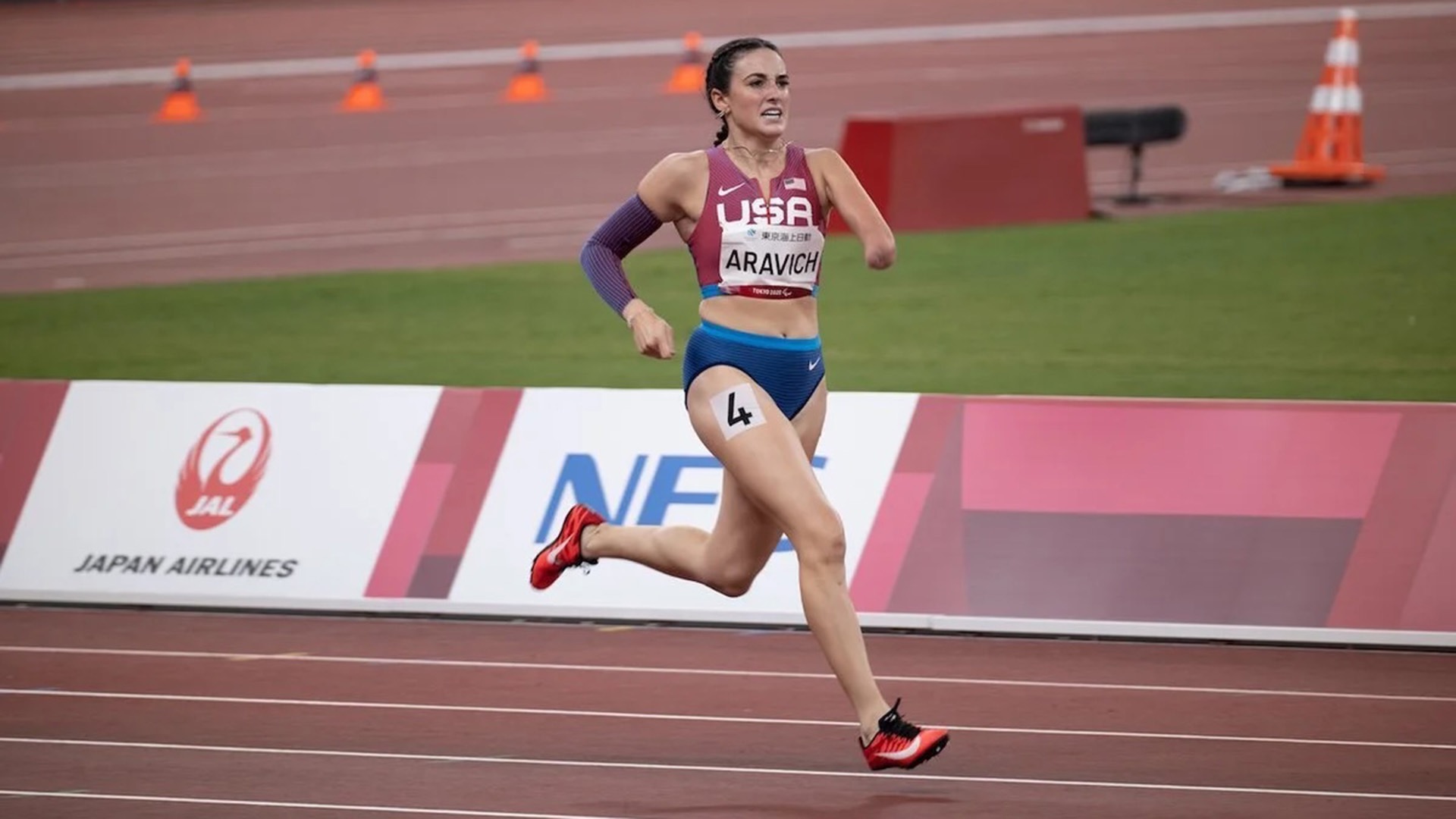
“I thought if I ever get this opportunity to go to the Paralympics, to wear Team USA, I can’t just do it for me and my athletic career. I have to do something with it that has a bit more meaning or value.”
Making the world stage … twice
Aravich’s Paralympic journey required her to bet on herself and try new things she never thought possible. From managing her time between training and work to learning a new event, the 400-meter T47 race, she became used to being uncomfortable.
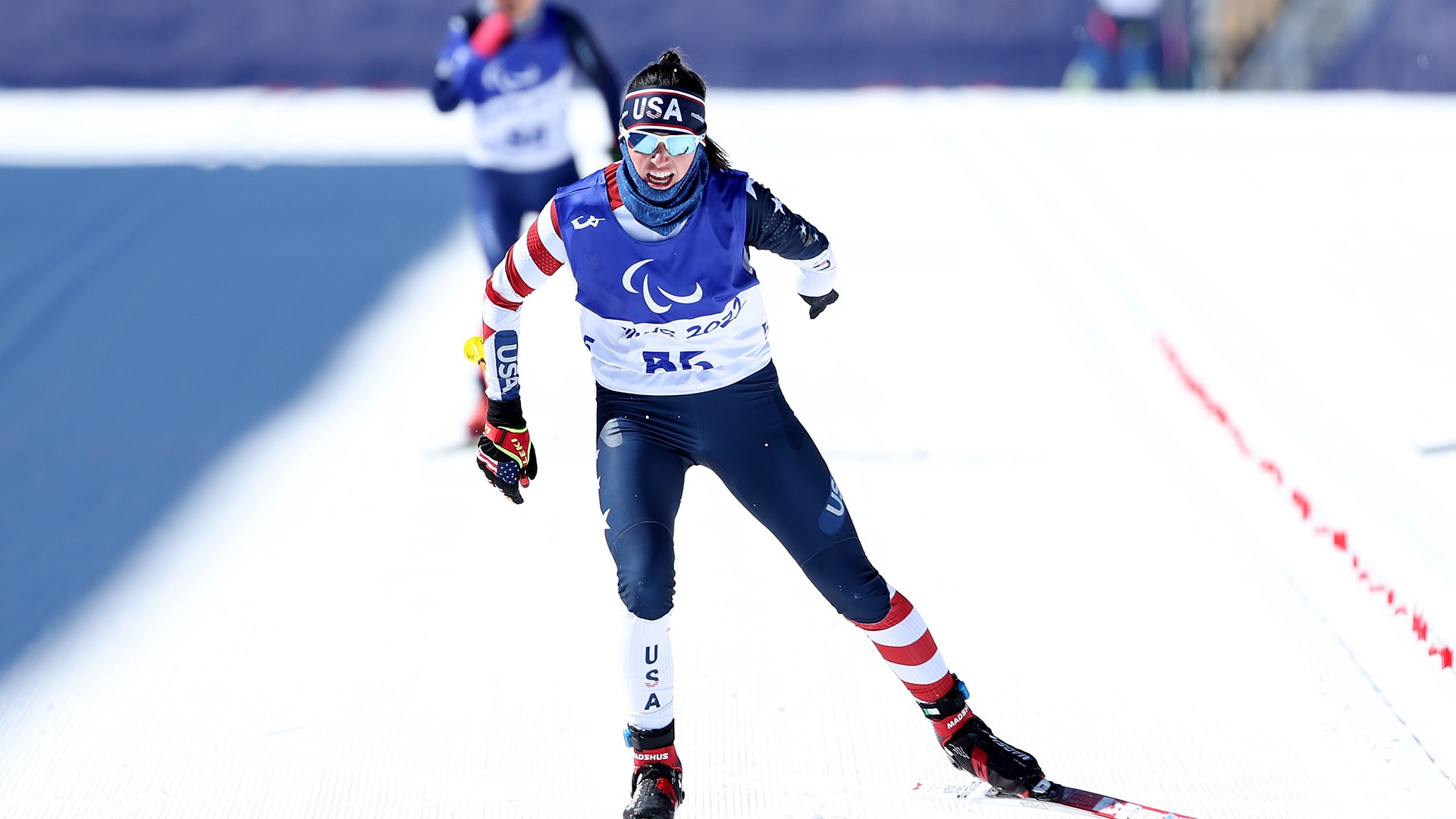
Her resolve was really put to the test when the COVID-19 pandemic canceled her track competitions. Once again, she bet on herself and tried not just a new event, but new sports entirely in biathlon and cross-country skiing. With virtually no skiing experience, she dove right in and joined a local biathlon club before training with the U.S. Paralympic Nordic team. Years later, she is known as the Biathlon Bandit and still enjoys learning more about the sport.
“(For me), it’s definitely always been this concept of having to commit to something before you even know if you love it yet,” Aravich said. “That’s what I had to do when I went to college, committing to a sport that I don’t even know if I love because I’ve only done it a short time … same with running the 400 meters and now with cross-country skiing. People ask me now what do I love about cross-country skiing and I’m like, ‘I’m still in the discovery process.'”
For still being in the “discovery process,” Aravich has been able to accomplish a lot. In 2021, Aravich competed in her first Summer Paralympics Games in Tokyo. Just six months later, she traded the track for the snow and competed in the Winter Paralympic Games in Beijing — becoming one of the few athletes to compete in both the Summer and Winter Paralympics.
Putting her purpose to practice
When she returned home, Aravich began using her experience as a Paralympic athlete and expertise as a storyteller to help promote the para sports community. In 2022, she became a digital media coordinator for the United States Olympic & Paralympic Committee. This led to Aravich starting her own social media company, Culxtured, in 2024, which focuses on amplifying the stories of para athletes.
As she continues her own Paralympic journey, Aravich aims to keep the promise she made to herself to use her career for a higher purpose.
“We’ve seen growth in women’s sports, great growth for queer athletes in sports, and I think disability will hopefully be our next domino to fall,” Aravich said. “It’s just something that I feel like I am called to do because I could never just be an athlete. I have to do more.”