

The former Amherst ice hockey player turned her childhood shyness into a superpower for connection
Alyssa Xu loves stories.
Whether chatting over tea with one of her Rhodes Scholarship classmates, becoming the managing editor of an Asian American Pacific Islander student-athlete magazine or being a listen-first leader when she was on the hockey team at Amherst, Xu has turned to stories to understand people.
“When you develop strong relationships, you get to know each other’s stories, and your experiences weave together,” she said. “I am just genuinely curious where someone was from, how they became the person they are today and what they hope to be in the future.”
Currently a Rhodes Scholar earning a degree in transitional health sciences at the University of Oxford in England with plans to go to medical school after graduation, Xu was an ice hockey student-athlete at Amherst, where she studied neuroscience.
During her four years as a student-athlete, she studied how auditory information is encoded in the brain. Her most formative research came from an independent study on physician communication strategies that could decrease vaccine hesitancy and improve pandemic preparedness.

On the ice, she contributed to Amherst’s runs to the finals of the NCAA Division III Ice Hockey Championship in 2023 and 2025, earning All-Tournament Team and second-team all-conference honors from the New England Small College Athletic Conference her senior year.
Xu finished in the Top 30 for the NCAA’s Woman of the Year award, which honored graduating student-athletes who excelled in academics, athletics, community service and leadership.
But her success in the classroom and rink is only a part of her story.
Her story starts with her parents, Yan Zhuang and Wilson Xu, who immigrated from China to Canada, settling outside Bayside, New Brunswick.
The first thing they did was put Alyssa and her brother, Andrew, in every sport possible. Being Chinese in a town of multigenerational Canadians, the Xus knew sports would lead to friendships and community.
At 5, Xu remembers joining a friend at hockey practice. Watching, then eventually putting on skates herself, she fell in love.
“Just being Canadian, everyone skates as a baby,” Xu said.
As Xu’s love for the sport grew, so did her awareness that she was often the only Asian player on the ice.
At times, players would make backhanded comments or even outright racial slurs.
“Growing up, there were a lot of instances where you face little moments of discrimination, sometimes big moments, sometimes little ones that you even question if it is discrimination, but then you question, ‘Should I be questioning that it’s discrimination?’ All these complicated mental processes that go on, knowing that you quite obviously don’t look like anyone else on the team.”
Coaches would tell her to call for the puck louder, be more assertive, more confident. But already shy by nature, Xu found herself retreating further in those moments.
Then, in 11th grade, Team China invited Xu to an Olympic training camp. Sitting in the locker room, Xu experienced something she never had before: “We’re all Chinese.”
“When I was on the ice with girls that looked like me, I felt so much more confident and felt like I could call for the puck. That’s where I realized, ‘Oh, this is what it means to feel fully welcomed and fully included and fully valued on a team.'”
Xu found her voice in China, and she sought out moments to share her experiences back in Canada and the United States. She wrote a firsthand story on her experience for Bouncing Back, an Asian American Pacific Islander student-athlete magazine, and became the managing editor of the publication.
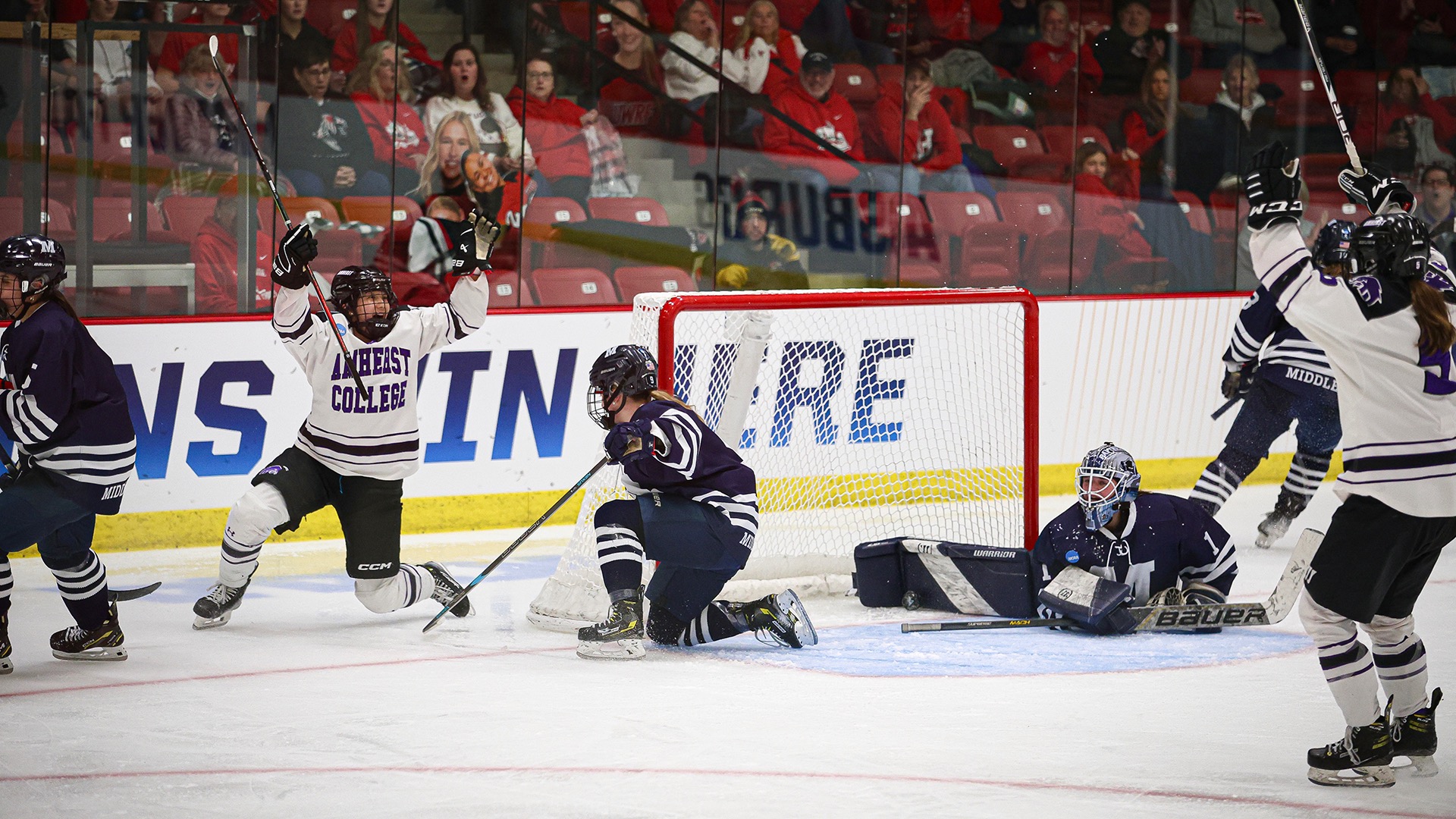
When she arrived on Amherst’s campus, Xu prioritized becoming the team’s diversity, education and inclusion representative.
“Working as a DEI rep at Amherst, I saw that everyone is different in a multitude of ways. Being diverse isn’t just being diverse in ethnicity or race. It’s being diverse in thought and perspective.”
As a DEI rep, Xu focused on celebrating those differences. On Lunar New Year, she and another Chinese teammate led a team celebration where they made dumplings and talked about family traditions.
“There was that first feeling of hesitation because I didn’t know how it was going to be received. But as soon as I started talking and my teammates were actively engaged and showing genuine curiosity, that hesitation went away,” she said. “We wanted our team to share and celebrate all these fun cultural experiences that you wouldn’t get if you didn’t grow up in an Asian household.”
That bond between teammates was what initially brought Xu to Amherst.
During the recruiting process, the coach connected the recruits with current players in their majors. Calling her potential teammates, she could picture herself enjoying a slow Sunday at a cafe together. At home games, professors usually take up the front row to support their students. She was sold.
“That’s just so sweet and makes playing at a place like Amherst so special,” she reflected.
The academic rigor of Amherst also appealed to Xu.
“With us being a DIII school, the coach gave us lots of freedom to pursue any major we wanted. … Our goal here is to set up the rest of our lives.”
Xu chose a major in neuroscience because she always has been fascinated by the brain, especially as she grew up with migraines and wanted to learn how to manage them.
“What I really came to appreciate about neuroscience is that it’s so interdisciplinary.
So you end up taking classes in biology, chemistry, physics, psychology, and you get to piece together different parts of each of those disciplines.”

Yet Xu noticed one part of neuroscience that her coursework didn’t focus on: stories.
As a Rhodes Scholar, she is writing a paper on the importance of stories and storytelling as the backbone of any physician-patient interaction. Part of the story comes from the words patients say.
From Xu’s perspective, nonverbal cues can tell an equally compelling story.
“How they’re sitting in the room or if their eyes are darting around or if there’s multiple people, how they’re interacting with each other. A lot of these unspoken gestures or subconscious indications of what’s really important to them is something you pick up on when you’re sitting around a locker room that I think is very applicable to medicine.”
Throughout her life, Xu has been more of a listener than a talker. Her quiet nature has become an emotional intelligence superpower.
“It’s important to be a listener and be able to think about who’s not participating, or if someone’s hands are shaking or someone’s posture. I grew up as a very quiet person, so my leadership style leans more on picking up on those details and being able to support from there.”
In her career in medicine, Xu is applying the same principles.
“Picking up on things that aren’t said is something I’ve been wanting to bring into medicine,” she said.
Xu shadowed a second-generation Chinese doctor who served Chinese immigrants who spoke English as a second language. Xu noticed some patients’ anxiety at the language and communication barriers. Although she didn’t know a lot of Chinese, she used what she knew to communicate.
“You could feel the energy change in the room. Their anxiety and fears were lessened because it was familiar. It stuck with me and made me think about other ways we can share this connection,” she said.
“It can be so many different things, but it shows how powerful it is to have something in common with someone else.”