

With more seats and voting power, student-athletes are more involved than ever in DI decision-making
Sam Edwards did not set out to sit at the same table as university presidents, conference commissioners and athletics directors within the NCAA Division I governance structure.
The Michigan State football player got his start in governance the way many college athletes do — through his campus Student-Athlete Advisory Committee.
That path has since taken him to the NCAA Division I Board of Directors and the Division I Football Bowl Subdivision Oversight Committee, where he has brought his own ideas on calendar structure to the table.
His rise reflects something bigger happening across Division I.
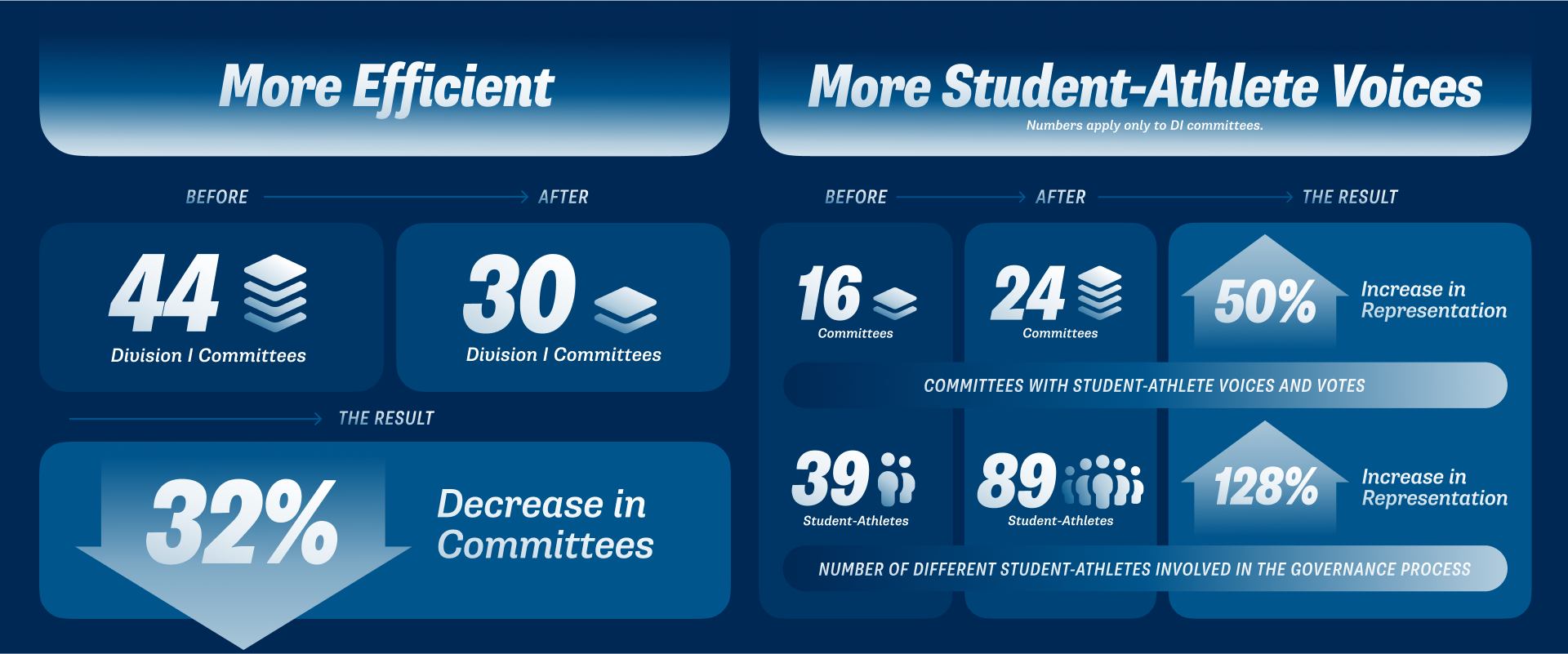
Under the governance restructuring approved by the Division I Board of Directors in August 2025, the number of different student-athletes involved in the Division I governance structure grew from 39 to 89 — a 128% increase. At the same time, the number of committees with student-athletes in voting seats grew from 16 to 24, a 50% increase.
Related: Inside Division I’s new governance structure.
In short, more student-athletes are no longer just being consulted. They are voting in the rooms where Division I decisions are made.
Those seats are filled more deliberately, too. Committees like the Board of Directors and the Cabinet now require representation from SAAC, football, and men’s or women’s basketball — and at least one student-athlete on each must be actively recruited and receiving direct name, image and likeness school payments, ensuring that the voices in the room reflect the current reality of college sports.
“Division I is in a period of change unlike anything we’ve seen in the history of college sports, and the student-athletes serving on these committees are helping us navigate it in real time,” said Tim Sands, president at Virginia Tech and chair of the Division I Board of Directors. “Their perspective isn’t supplementary to good decision-making — it’s essential to it. You cannot make good rules for people whose experience you don’t understand.”
The student-athletes now filling those seats come from every corner of Division I, and they got there in very different ways.
—
For Noah Mulvaney, the path to a national committee had nothing to do with SAAC. A two-time team captain for Bucknell wrestling, Mulvaney was nominated for the Division I Men’s Wrestling Oversight Committee by his head coach and athletics director, who saw both his leadership and his investment in the sport’s future.
After he was selected, Mulvaney expected the role to be modest. Instead, he found himself voting on major issues, including NCAA Transfer Portal timing and recruiting rules.
“I thought I’d just have a little say in things, but I’ve had a vote in some big rule changes — on when the Transfer Portal opens, on the recruiting timeline,” Mulvaney said. “I never knew I was going to have that much influence.”
Mulvaney is the only student-athlete on the wrestling committee, which has made him deliberate about how he represents the community. After meetings or when ideas are floated for feedback, he goes back to teammates, reaches out to his broader network in the wrestling world and tries to hear multiple perspectives before speaking.
“I don’t want to just represent myself,” he said. “I want to represent the whole wrestling community, which I feel is what I’ve been doing so far.”
Mulvaney’s influence on decision-making does not always make headlines but directly impacts student-athletes. He was consulted on championship belt designs for this year’s NCAA wrestling championships across all divisions, including the inaugural National Collegiate Women’s Wrestling Championships. His perspective was also critical in the Division I Men’s Wrestling Oversight Committee’s vote to move the Transfer Portal dates for the sport.
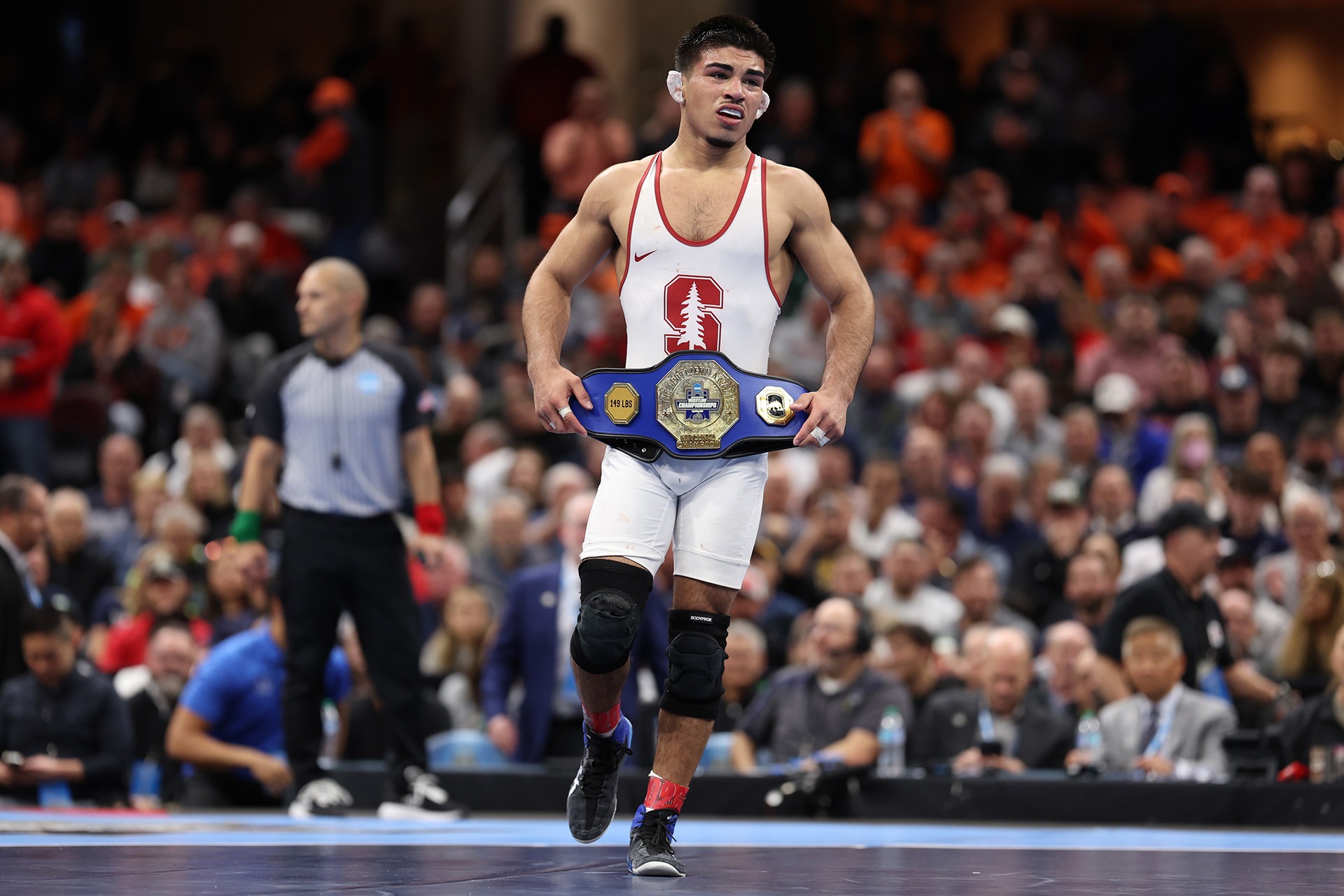
“Having Noah on our oversight committee has had such a positive impact. He’s brought valuable perspective and thoughtful feedback to every conversation,” said Matt Valenti, chair of the Division I Men’s Wrestling Oversight Committee and the University of Pennsylvania head coach. “Meetings with head coaches, administrators and NCAA staff can be intimidating, but Noah has willingly spoken up and played an important role in our work. We are incredibly fortunate to have a student-athlete like Noah on our committee.”
The same dynamic plays out in other sports. Paige Sayler, a senior softball player at Central Michigan, found her way to a national committee through a more familiar route — but the influence she’s had has surprised her just as much.
Sayler started attending campus SAAC meetings as a sophomore and eventually became chair of the Mid-American Conference Council of Student-Athletes. That role led to a seat on the Division I Student-Athlete Advocacy Committee in 2025. When the new sport-specific oversight committees launched last fall, she was already on the radar.
Because she was a softball player with experience speaking on behalf of student-athletes, she received a call inviting her to join the Division I Softball Oversight Committee alongside three other softball student-athletes: Florida State’s Jaysoni Beachum, Washington’s Alexis DeBoer and Kentucky’s Ella Emmert.
“I’m one of four softball players on the oversight committee. I’m one of 32 student-athletes on (Division I SAAC),” Sayler said. “I have to sometimes take a step back and really look at the perspective of where I am.”
That perspective has translated into tangible contributions. Sayler raised the idea of surveying softball student-athletes across the country to collect broader feedback on altering the recruiting timeline — a conversation the committee had been actively working through. The committee backed the idea, and the survey brought more student-athlete perspective to the discussion.
“That was the first moment where I realized, OK, they are really taking student-athlete input seriously,” she said. “That definitely allowed me to feel a lot more welcomed in the space.”
—
For TJ Johnson, a basketball player at VMI, the opportunity to join the Division I Board of Directors came through his involvement with the NCAA Division I Men’s Basketball Student-Athlete Engagement Group, which had already given him a feel for what national governance looked like. The engagement group was formed in 2023 with a goal of amplifying student-athlete voices in basketball on key initiatives, legislation and issues.
Serving on the Board of Directors since December has deepened his connection to those areas.
“When you’re actually in it, you can understand the difficulties and the challenges that arise in college sports,” Johnson said. “There’s a lot to take into consideration. It’s been really fascinating for me to learn about all of that.”
DeAmez Ross arrived at his committee seat through a different kind of surprise: an email. A baseball player at the University of Central Florida, Ross had been involved in SAAC at Florida State before transferring to UCF. When an NCAA email hit his inbox about a seat on the Division I Baseball Oversight Committee, he almost didn’t appreciate what was being offered.
“I didn’t know how big of an honor that was until I told my coach,” Ross said. “My coach was like, oh, that’s like the highest you can get in our sport.”
The baseball committee includes three other student-athletes, currently Toledo’s Troy Sudbrook, Santa Clara’s Johnny Luetzow and FDU’s Luke Russo. Ross said because the student-athlete representatives compete in four different conferences, their varied experience and perspective allow for richer, more representative conversation than a single voice could provide.
“It’s been one of the best experiences,” Ross said. “The other committee members genuinely ask us questions and really want to hear our feedback, which is amazing.”
What Ross values most about the room, though, is something simpler: the candor it allows.
“We’re actually playing in real time in this sport,” he said. “I think we just give them the honest truth and our real-life experience. They really do value that.”
Every decision made in these rooms — on recruiting timelines, Transfer Portal windows, championship formats, eligibility rules — shapes the day-to-day reality of the student-athletes still competing under those rules. Coaches and administrators bring expertise and institutional knowledge; student-athletes bring something no one else in the room can: the unfiltered truth of what the current experience actually feels like.
“There is something irreplaceable about having someone at the table who went to practice yesterday and has a test tomorrow,” said Christopher Pietruszkiewicz, president at Evansville and vice chair of the Division I Board of Directors. “These student-athletes aren’t just representing themselves — they’re carrying the experiences of hundreds of thousands of college athletes into rooms where it matters. That’s not a small thing.”
Mulvaney put it directly: “The coaches and the administrators can have a view of how a decision is going to impact the student-athlete, but actually having the student-athlete there — expressing how this would make them feel or how this would impact their life — is a huge benefit for the committee.”
“The whole premise of this restructuring was that better decisions come from better-informed rooms,” said Josh Whitman, athletics director at Illinois and chair of the Division I Cabinet. “We’re already seeing committees surface issues and ask questions they wouldn’t have thought to ask before, and the student-athletes on these committees are well-informed and experienced, and their input is essential. Thanks to the streamlined structure, these committees are acting more quickly and with more student-athlete input than ever before. That combination — efficiency and representation — is exactly what we set out to build.”
—
For each of the student-athletes now serving in those rooms, the experience has been as personally transformative as it has been professionally formative.
For Edwards, who studied political theory at Michigan State and is applying to law school, the governance experience has connected threads that already interested him.
“You have the legal side, the policy side, the sports side — it all comes together,” he said.
Edwards has built relationships with athletics directors, conference administrators and university presidents, and he expects to carry those connections well beyond his playing days.
Mulvaney, a finance major at Bucknell, said the experience has opened possibilities he had not considered.
“It has opened up some ideas of me possibly wanting to pursue something in this realm,” he said. “I enjoy it a lot.”
Sayler is heading to Boston College to pursue a master’s degree in sports administration — a path connected, she said, to a conversation that began through her MAC involvement.
“Opportunities like these have definitely connected me and helped me network more,” she said.
Serving in governance has opened doors for the student-athletes in those rooms. It has also sharpened their sense of responsibility to those who will follow them.
Johnson said he has been thinking about two younger brothers — one currently playing college basketball, one hoping to — when he shows up to Board of Directors meetings.
“How can I make their lives better? That’s how I’ve been approaching this whole process,” he said.
Mulvaney also has his eyes on the future.
“Being able to help grow the sport of wrestling and being able to have an influence on how the wrestling world is going to be in the future is so fulfilling and rewarding for me,” Mulvaney said.
Ross said his advice to any student-athlete curious about getting involved is straightforward: Be outspoken, and trust that it matters.
“You never know how one opinion or one thought you have can really help,” he said.
That opportunity has never been more accessible. The new governance structure has created more entry points than have ever existed — through sport-specific oversight committees, student-athlete engagement groups, and campus and conference SAAC programs that connect to the national Division I Student-Athlete Advocacy Committee.
That expanded role for student-athletes in shaping college sports is also reflected in a recent update to SAAC’s name, shifting from “Advisory Committee” to “Advocacy Committee.”
For student-athletes who have something to say about the state of their sport, the structure now exists to make sure those voices reach the rooms where decisions are made.
“You have a platform and you have influence,” Mulvaney said of his message to student-athletes.
Edwards added: “There’s no better time than now to get involved and have your voice heard.”