
Underrecruited quarterback became a record-setting Purdue star, Super Bowl MVP and community leader
Drew Brees did not pick Purdue to bolster his NFL prospects.
He chose a school he barely knew, in a part of the country he had never pictured for himself, because of its academic prestige and an opportunity he never expected football to extend. That unlikely decision — to leave Texas for a struggling Big Ten Conference program built on academics and a wide-open offense — changed the course of his life.
By the time he left West Lafayette, Indiana, Brees had become one of the most decorated players in Purdue history. He set two NCAA records, 13 Big Ten records, finished twice as a Heisman Trophy finalist and led the Boilermakers to the 2000 Big Ten championship and a 2001 Rose Bowl appearance. The habits formed and traits enhanced in those years fueled a 20-year NFL career highlighted by a Super Bowl title, countless records and a community-driven legacy that continues to grow.
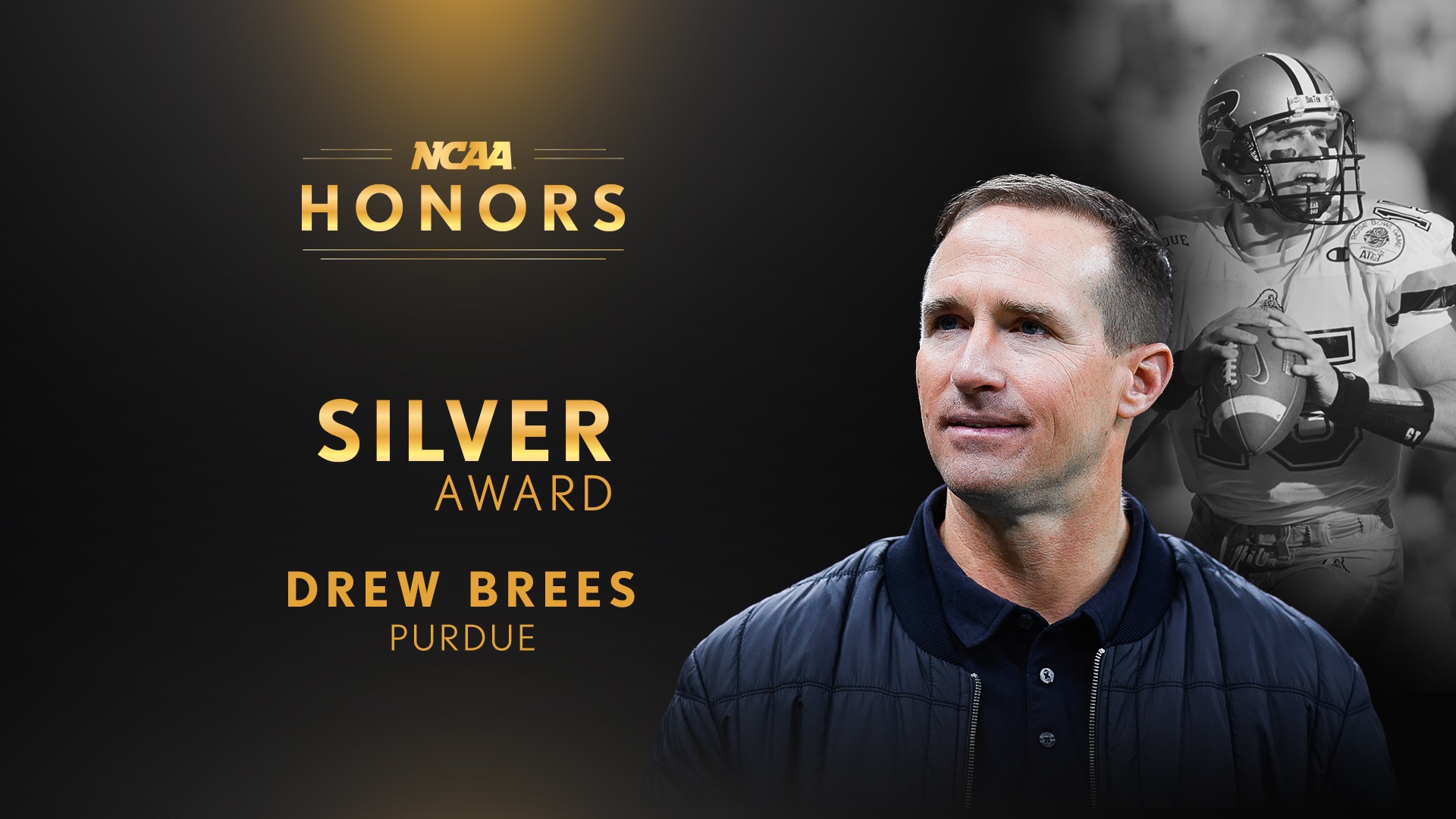
Now, 25 years removed from his last college snap, the quarterback who helped lift Purdue from the bottom of the Big Ten to the top of the conference is one of four recipients of the 2026 NCAA Silver Anniversary Award. The honor recognizes former student-athletes on the 25th anniversary of the conclusion of their college athletics careers who have excelled in their professional lives and continue to exemplify the values of collegiate athletics.
"It’s an incredible honor. First off, I can’t believe it’s been 25 years. I don’t feel old. I’m not old. I’m prolonging my prime," Brees said, with a smile. "It just brings back a rush of memories, of the opportunity that I had to go to Purdue University and be a part of such an incredible college environment.
"It just gives me so much pride, and it comes with a great sense of responsibility."
Finding Purdue
Brees never expected his path to run through West Lafayette.
"The way that I landed at Purdue was highly unlikely," he said.
The son of two Texas A&M graduates, Brees grew up in Austin and watched Southwest Conference games on Saturdays. He assumed he would follow friends to one of the many in-state schools. Then came a senior year defined by both doubt and success.
"Coming out of high school, I think I was 6 foot, 175 pounds, and I had torn my ACL at the end of my junior season," Brees said. "So I had this big old clunky knee brace, wasn’t the fastest … but just kind of got the job done. We won a state championship my senior year in 5A, which was the biggest division in Texas at the time, and I was 5A state player of the year."
Still, not a single Texas school offered Brees a football scholarship.
When coach Joe Tiller left Wyoming to take over at Purdue in 1997, he saw an opening. Brees laughs now about his first impression of the program that would change his life. During a high school practice, one of his coaches pointed out a Purdue recruiter, sporting a black and gold jacket on the sidelines.
"He’s here to see you," Brees’ high school coach told him.
"Where’s he from?" Brees asked.
"Purdue."
"Ivy League. That sounds great," Brees responded.
The confusion underscored a few things. Namely, Brees was intrigued by the strong academic opportunity above anything football-related. This worked in Purdue’s favor, as its program was among the worst in the Big Ten at that time.
"Honestly, the most attractive thing was I am going to go and get a great education," Brees said. "I really never thought that football would take me anywhere beyond college."
Raising the bar at Purdue
Purdue’s program had been down when Brees arrived. The Boilermakers had not posted a winning season in more than a decade, and Tiller’s first recruiting class was small and largely overlooked.
"Our recruiting class was about 14 kids," Brees said. "At that time, the average recruiting class was between 25 to 30 guys. Our class was just kind of thrown together. We were tightly bonded because not a lot of us were highly recruited guys.
"I remember seeing someone ranking the recruiting classes and, of course, there was Michigan and Ohio State (at the top), and Purdue is dead last in the Big Ten."
This created added motivation for Brees and his teammates.
Brees described their mentality as: "We’re going to show them who the worst recruiting class of the Big Ten is. We’re going to leave here as champs."
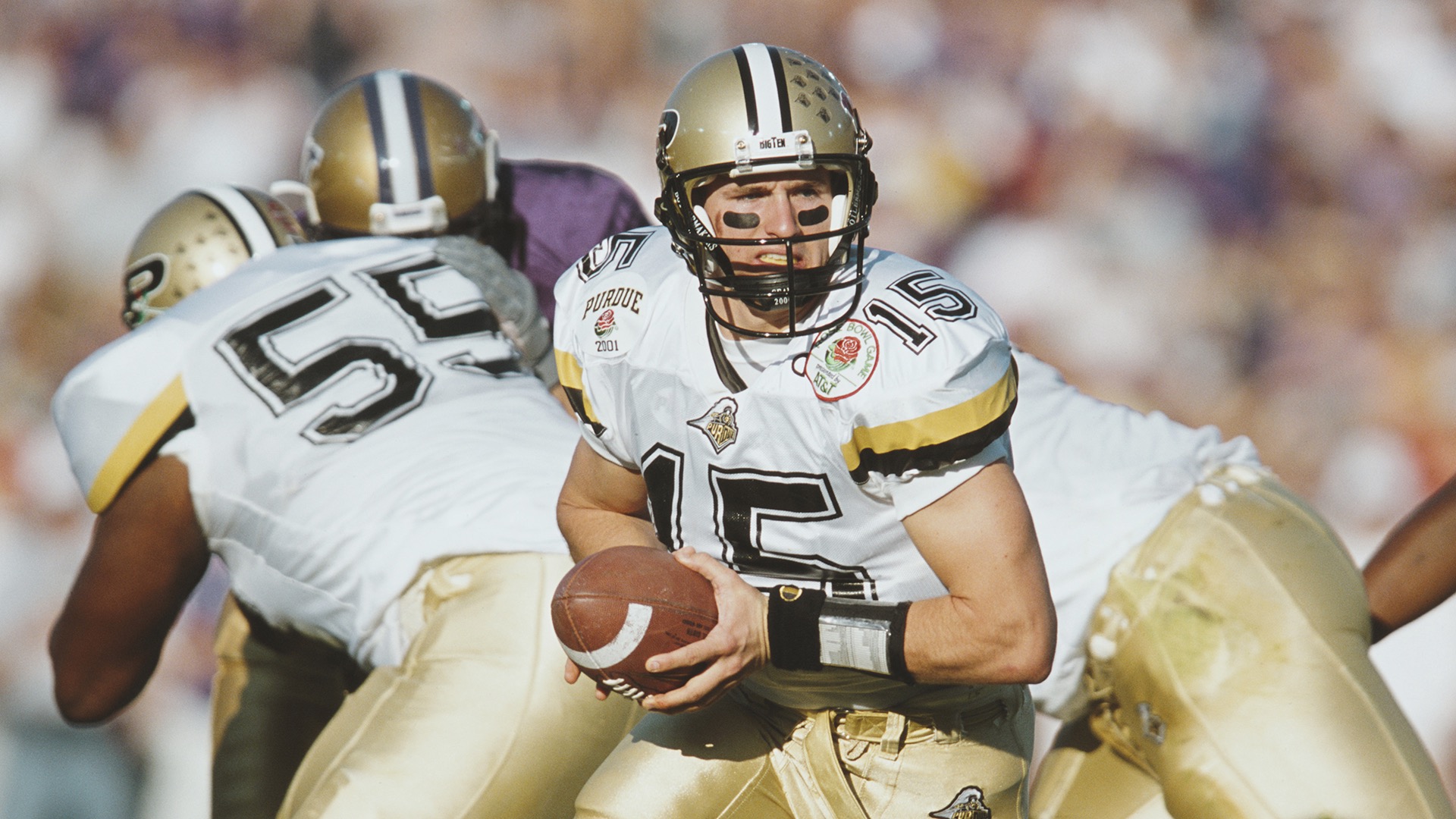
As a senior in 2000, Brees led Tiller’s team to a Big Ten championship and the program’s first Rose Bowl appearance in 34 years. That season provided countless memories, including three home games that ended with a sea of black and gold fans on the field.
"Each one of those moments kind of stands alone," Brees said of marquee home wins against Michigan, Ohio State and Indiana in 2000. "Those moments within that season, it’s just hard to fathom that we had victories like that and we made people feel so compelled to rush the field and make it a celebration."
Along the way, Brees twice was named Big Ten Offensive Player of the Year. Leading Tiller’s "basketball on grass" spread offense, Brees set 19 school records in his four seasons. His 1,026 completions, 1,678 attempts, 11,792 passing yards and 90 passing touchdowns all rank No. 1 in Purdue history.
"Spreading it out, throwing it 50 times a game, that was unheard of in the Big Ten. The Big Ten was known as the three yards in a cloud of dust, two-back, pound the football and not a lot of variety or creativity in the passing game," Brees said. "I think Tiller just totally blew that wide open."
Tiller, who died in 2017, gave equal credit back to the quarterback at the center of the turnaround.
"He raised the program," Tiller told the LA Times in 2001 after the Rose Bowl. "He created a national awareness of Purdue football."
An education that keeps working
For all the records and field-rushing wins, Brees still comes back to the decision that drew him north in the first place: academics.
"That was why I chose Purdue," he said. "I wouldn’t have even considered Purdue if it wasn’t for the academic reputation. The ability to play the spread offense and the Big Ten was kind of a throw-in. My decision was really based on academics. I took great pride in that."
That pride led to an industrial management degree from the prestigious Krannert School of Management. En route to his diploma, he became a two-time Academic All-American and three-time Academic All-Big Ten selection and earned Academic All-American of the Year honors in 2000. In 2016, he was inducted into the College Sports Communicators Academic All-America Hall of Fame.
"I never thought that I would be a professional athlete," he said. "I love the idea of being a student-athlete in college and having that experience and feeling like that was really going to help develop me in a lot of ways. But it was really all about the education."
He remembers courses as clearly as big games because of how they forced him to collaborate and lead.
"It’s teaching you a lot of time management skills, organizational skills," he said. "All those things have certainly applied to me and my life after football."
Those experiences helped shape how he gives back. When he and his wife, Brittany, made a major gift to Purdue to create the Brees Academic Performance Facility, it was rooted in a belief that academic spaces matter as much as stadiums.
"The academic portion of the student-athlete is just as important as what you’re going to do on the field," he said. "The best thing that we could do is create the best learning environment, growth environment that we could."
Faith, family, football and service
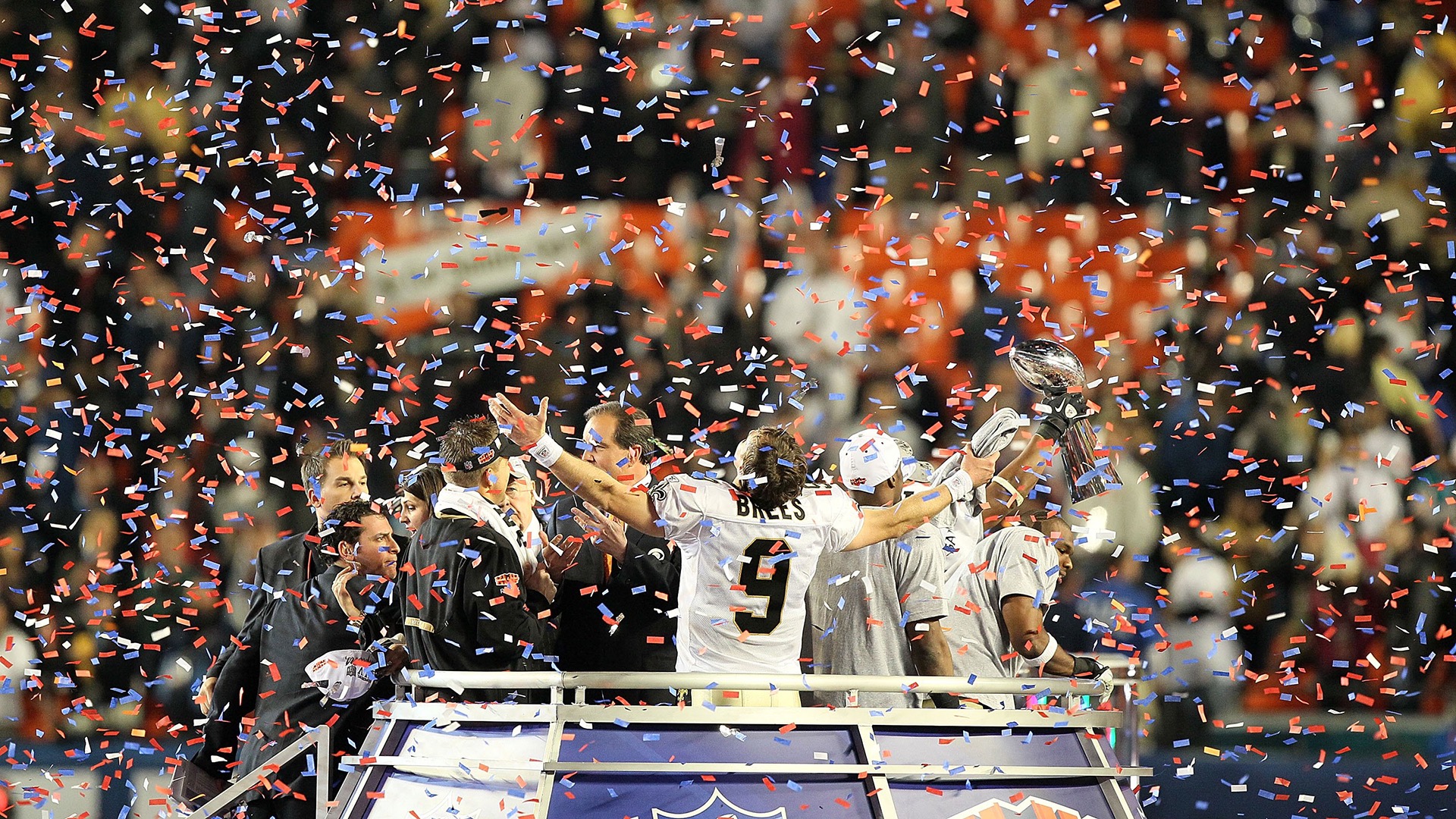
If there is a through line from Austin to West Lafayette to New Orleans — where he played 15 of his 20 NFL seasons and won Super Bowl XLIV for the Saints — Brees sees it in the example of people who put others first.
His maternal grandfather, Ray Akins, comes to mind first, a man who served in World War II and became one of the winningest coaches in Texas high school football history.
"All he did was serve his community, mentor young people and try to represent all the right things, a pretty easy example to follow," Brees said.
Brees’ connection to his grandfather created a passion for engaging in United Service Organization trips to visit U.S. military members around the world.
"They’re doing really tough jobs, and just to give them a little taste of home, but also just to give them a little excitement … I really enjoy that, spending time with our troops that way," he said.
Brees’ philanthropic career now rivals his football résumé, impressive considering he retired as the league’s all-time leader in career passing yards before being passed by Tom Brady. Through the Brees Dream Foundation, which launched in 2003, he and his wife, Brittany, have supported cancer patients and their families, helped build and rebuild schools, parks and athletic fields, expanded health care access and invested in communities in New Orleans, San Diego (where he spent five years as Chargers quarterback) and West Lafayette. Since launching in 2003, the foundation has contributed more than $50 million to charitable causes globally.
"We always knew that when we had the opportunity, we wanted to establish our own foundation to build, improve the quality of life for patients with cancer and also create care education opportunities for children and families in need," Brees said. "We’ve been able to engage in a lot of those projects with some incredible people and organizations."
Brees’ passion to give back has roots in several places, though arguably none that are stronger than Purdue.
"I’ve always been so grateful and appreciative for the opportunities that I’ve had," he said. "Never in my wildest dreams did I think I’d have a chance to go and be a college student-athlete at a place like Purdue University that’s given me so much. It’s really set me up for everything that I’ve been able to accomplish in life after that and will continue to."
That perspective also shapes how he accepts the Silver Anniversary Award — as both recognition and reminder of past winners like Peyton Manning, Troy Aikman and Bob Griese.
"I think of all the people who have won this award in the past and just their contributions to the game," Brees said. "And I think the way that we all just take it as a great sense of responsibility to continue to carry on the legacy for what this award represents.
"The journey continues. There is still so much to be done."